

Navigating Foreign Exchange Management Tribunal Proceedings: Expert Legal Guidance by Rajendra Civil Law Firm
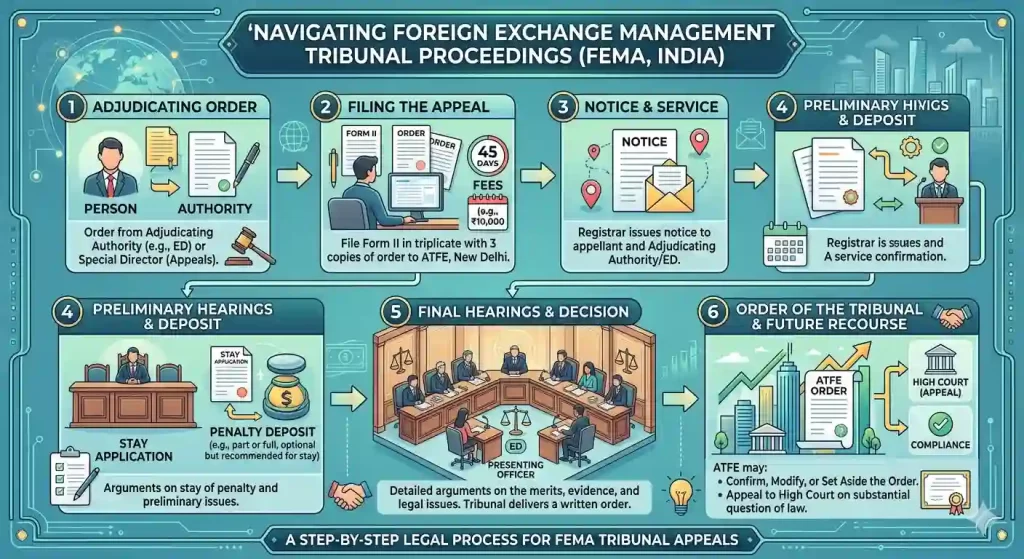
Understanding FEMA Tribunal Proceedings: Legal Framework, Jurisdiction, and Compliance Obligations
What Is the Foreign Exchange Management Tribunal and How Does It Operate?
The Foreign Exchange Management Tribunal (FEMT) adjudicates appeals against orders passed by Adjudicating Authorities under FEMA. Foreign Exchange Management Act, 1999 (FEMA) replaced FERA, 1973 as India’s primary foreign exchange law. Consequently, FEMA transformed foreign exchange violations from criminal offences into civil contraventions with monetary penalties. Rajendra Civil Law Firm guides clients through every stage of FEMT proceedings with precision.
FEMA 1999 regulates all foreign exchange transactions, capital account transactions, and cross-border payments in India. The Reserve Bank of India (RBI) and Enforcement Directorate (ED) enforce FEMA provisions jointly. Moreover, Adjudicating Authorities appointed under FEMA Section 16 conduct first-level adjudication of contraventions. Appeals from their orders lie before the Foreign Exchange Management Tribunal under FEMA Section 18.
Key Legal Issues in Foreign Exchange Management Tribunal Proceedings
FEMA contravention cases involve complex legal issues spanning foreign exchange, banking, and corporate law. These issues arise from capital account violations, current account defaults, and reporting non-compliance. Therefore, experienced specialised legal counsel becomes indispensable for effective FEMT representation and defence. Rajendra Civil Law Firm identifies and addresses every legal issue in FEMA proceedings comprehensively.
The most common legal issues in FEMA Tribunal proceedings include the following contraventions:
- Illegal Remittances: Transferring foreign exchange outside LRS limits without RBI prior approval violates FEMA.
- FDI Violations: Receiving foreign direct investment in prohibited sectors or without proper reporting.
- FCCB Non-Compliance: Foreign Currency Convertible Bond issuance without regulatory approval or end-use violations.
- ECB Contraventions: External Commercial Borrowing beyond permitted limits or for prohibited end-uses.
- ODI Violations: Overseas Direct Investment made without RBI approval or beyond permitted thresholds.
- Reporting Defaults: Failure to file FCGPR, FLA, ODI, or APR returns within prescribed RBI timelines.
- FERA Legacy Cases: Proceedings initiated under old FERA provisions still pending before enforcement authorities.
FEMA Enforcement, Adjudication, and Tribunal Appeals: Complete Legal Process Guide
Adjudication Process: From Show-Cause Notice to Tribunal Appeal
FEMA enforcement begins when the Enforcement Directorate issues a Show-Cause Notice to the alleged contravener. The Adjudicating Authority then examines evidence, conducts hearings, and passes penalty orders under FEMA Section 13. Consequently, aggrieved parties may appeal penalty orders before the Foreign Exchange Management Tribunal. Rajendra Civil Law Firm provides end-to-end representation from SCN response to FEMT appeal.
The complete FEMA adjudication and appeal process follows these sequential steps:
- Enforcement Directorate conducts investigation and issues Show-Cause Notice under FEMA Section 16.
- Accused files a reply to the SCN with supporting documents and legal submissions.
- Adjudicating Authority conducts personal hearing and examines evidence presented by both sides.
- Adjudicating Authority passes an order imposing penalty or compounding the contravention.
- Aggrieved party appeals before FEMA Appellate Tribunal within 45 days of order receipt.
- FEMT hears arguments, examines records, and passes appellate order confirming or setting aside penalty.
- Further appeals against FEMT orders lie before the High Court under FEMA Section 35.
Show-Cause Notice Response: Building a Strong FEMA Defence
An effective SCN response forms the foundation of every successful FEMA defence strategy. The reply must address each allegation with factual rebuttals, legal arguments, and documentary evidence. Additionally, procedural defects in the SCN itself may provide grounds for challenging the entire proceeding. Rajendra Civil Law Firm drafts legally precise SCN replies that maximise clients’ chances of favourable adjudication.
A comprehensive FEMA Show-Cause Notice response must address the following elements:
- Factual Rebuttal: Point-by-point denial or explanation of each alleged FEMA contravention clearly.
- Legal Submissions: Statutory interpretations, RBI circulars, and judicial precedents supporting the defence.
- Documentary Evidence: Bank statements, RBI approval letters, and compliance records as supporting exhibits.
- Compounding Application: Where appropriate, voluntary compounding offer under FEMA Section 15 simultaneously.
- Jurisdictional Challenge: Challenge territorial or subject-matter jurisdiction of the Adjudicating Authority if applicable.
- Limitation Defence: Arguing that the SCN was issued beyond the three-year limitation period.
FEMA Compounding: Voluntary Settlement of Foreign Exchange Contraventions
Compounding under FEMA Section 15 allows voluntary settlement of contraventions by paying a negotiated penalty. RBI handles compounding for most FEMA contraventions, while ED compounds certain specified violations. Consequently, compounding avoids prolonged adjudication, reputational damage, and uncertainty of contested proceedings. Rajendra Civil Law Firm advises clients on compounding eligibility and negotiates minimal compounding fees effectively.
The FEMA compounding process involves the following key stages:
- Submit compounding application to RBI or ED with full disclosure of contravention details.
- Pay application fee and provide complete transaction details and supporting documentation.
- Attend compounding hearing before the authorised RBI or ED officer for consideration.
- Receive compounding order specifying the compounding amount payable by the applicant.
- Pay the compounding amount within 15 days to conclude the compounding proceedings.
FEMA Appellate Tribunal: Jurisdiction, Powers, and Procedures
The FEMA Appellate Tribunal currently functions as the Appellate Tribunal for Foreign Exchange (ATFE) in India. It is constituted under FEMA Section 18 and exercises appellate jurisdiction over Adjudicating Authority orders. Moreover, ATFE has the power to stay penalty orders, call for records, and modify or set aside orders. Rajendra Civil Law Firm regularly appears before ATFE with well-prepared appellate submissions and arguments.
Key jurisdictional and procedural aspects of FEMA Appellate Tribunal include:
| Aspect | Detail | Legal Basis |
|---|---|---|
| Constitution | Presiding Officer + Members appointed by Central Government | FEMA Section 18 |
| Appeal Period | 45 days from Adjudicating Authority order receipt | FEMA Section 19(1) |
| Pre-Deposit | Mandatory deposit of penalty or portion before appeal admission | FEMA Section 19(1) |
| Stay Power | Tribunal may stay order on sufficient cause shown | FEMA Section 19(3) |
| Further Appeal | High Court appeal on questions of law within 60 days | FEMA Section 35 |
| Sitting | New Delhi (principal bench); circuit benches as notified | FEMA Rules |
Enforcement Directorate Investigation Powers Under FEMA
The Enforcement Directorate exercises sweeping investigative powers under FEMA and Prevention of Money Laundering Act. ED officers can summon persons, seize documents, and attach properties during FEMA investigations. Additionally, ED can arrest individuals under PMLA, 2002 for money laundering connected to FEMA violations. Rajendra Civil Law Firm defends clients during ED investigations and challenges illegal searches and seizures.
ED’s investigative powers under FEMA and PMLA that respondents must understand include:
- Summons Power (FEMA Section 37): ED can summon any person to furnish documents or statements.
- Search and Seizure (FEMA Section 37A): Authorised officers may search premises and seize foreign exchange.
- Provisional Attachment (PMLA Section 5): ED can provisionally attach properties linked to FEMA proceeds.
- PMLA Arrest (Section 19): ED may arrest persons having reason to believe they committed scheduled offences.
- Statement Recording: Statements recorded under FEMA Section 37 are admissible as evidence in proceedings.
PMLA and FEMA Intersection: Defending Money Laundering Allegations
FEMA contraventions frequently trigger parallel money laundering investigations under PMLA, 2002. Scheduled FEMA offences constitute predicate offences for PMLA proceedings when proceeds are laundered. Consequently, accused persons face simultaneous FEMA adjudication and PMLA criminal prosecution in parallel. Rajendra Civil Law Firm provides integrated defence strategy covering both FEMA and PMLA proceedings simultaneously.
Key differences between FEMA civil proceedings and PMLA criminal prosecution include:
| Parameter | FEMA Proceedings | PMLA Proceedings |
|---|---|---|
| Nature | Civil contravention | Criminal prosecution |
| Standard of Proof | Preponderance of probability | Beyond reasonable doubt |
| Penalty | Monetary penalty up to 3x contravention amount | Rigorous imprisonment 3–7 years |
| Arrest Power | No arrest under FEMA alone | ED can arrest under PMLA Section 19 |
| Bail | Not applicable (civil) | PMLA Section 45 twin conditions for bail |
| Attachment | FEMA Section 37A provisional attachment | PMLA Section 5 provisional attachment |
| Forum | Adjudicating Authority and ATFE | Special PMLA Court |
RBI Regulations: Capital and Current Account Transaction Compliance
RBI regulates all foreign exchange transactions through Master Directions, Circulars, and FEMA Notifications. Capital account transactions require prior RBI approval unless specifically permitted under FEMA Schedule I. Additionally, current account transactions are generally permitted subject to RBI directions and government restrictions. Rajendra Civil Law Firm ensures full RBI regulatory compliance to prevent FEMA contravention exposure.
Critical RBI compliance areas that attract FEMA Tribunal proceedings include:
- LRS Compliance: Liberalised Remittance Scheme permits individuals to remit up to USD 250,000 annually.
- FDI Reporting: FCGPR filing with RBI within 30 days of allotment of shares to foreign investors.
- ODI Returns: Annual Performance Reports filed with AD bank by December 31 every year.
- ECB Reporting: Monthly ECB-2 returns filed through AD bank with RBI for all ECBs.
- FLA Returns: Foreign Liabilities and Assets survey filed annually with RBI by July 15.
Special PMLA Courts and Appellate Forums for FEMA-Linked Criminal Cases
PMLA offences linked to FEMA contraventions are tried before designated Special Courts under PMLA Section 43. These courts have exclusive jurisdiction over money laundering prosecution and property attachment confirmation. Moreover, appeals from Special Court orders lie before the High Court having supervisory jurisdiction. Rajendra Civil Law Firm represents accused persons before Special PMLA Courts and appellate forums effectively.
The judicial hierarchy for FEMA-linked PMLA criminal cases in India includes:
- Special PMLA Court adjudicates money laundering prosecution and attachment confirmation orders.
- Adjudicating Authority (PMLA) confirms or revokes provisional attachment orders within 60 days.
- Appellate Tribunal for Money Laundering Act (ATFMLA) hears appeals against Adjudicating Authority orders.
- High Court exercises jurisdiction over ATFMLA orders and Special Court decisions on appeal.
- Supreme Court resolves constitutional questions and interprets PMLA provisions on further appeal.
Bharatiya Nyaya Sanhita 2023 and Bharatiya Nagarik Suraksha Sanhita 2023 in FEMA Context
Bharatiya Nyaya Sanhita (BNS) 2023 governs general criminal offences committed in connection with FEMA violations. BNS Section 316 covers cheating and fraud perpetrated through illegal foreign exchange transactions. Additionally, BNS Section 318 addresses criminal breach of trust in cross-border financial dealings. Rajendra Civil Law Firm defends clients facing BNS criminal charges arising from FEMA-related financial misconduct.
Bharatiya Nagarik Suraksha Sanhita (BNSS) 2023 governs criminal procedure for all FEMA-linked criminal matters. Key BNSS provisions relevant to FEMA enforcement proceedings include:
- Zero FIR (BNSS Section 173): File at any police station regardless of territorial jurisdiction for FEMA frauds.
- Anticipatory Bail (BNSS Section 484): Seek protection before ED arrest in PMLA-linked FEMA cases.
- Bail under BNSS 479: First-time offenders eligible for bail after serving half maximum sentence period.
- Chargesheet Timeline: Police must file chargesheet within 60 or 90 days of arrest under BNSS.
- Electronic Summons: BNSS permits service of summons and notices through electronic modes officially.
Bharatiya Sakshya Adhiniyam 2023: Digital Evidence in FEMA Tribunal Cases
Bharatiya Sakshya Adhiniyam (BSA) 2023 governs admissibility of evidence in all Indian courts and tribunals. BSA Section 57 recognises bank SWIFT messages, wire transfer records, and forex transaction logs as primary evidence. Consequently, digital financial records carry significant weight in FEMA adjudication and tribunal proceedings. Rajendra Civil Law Firm leverages BSA provisions to build evidence-rich defences in FEMA matters.
BSA 2023 provisions particularly valuable in FEMA Tribunal proceedings include:
- SWIFT message records and bank transaction logs admitted as primary electronic documentary evidence.
- Digitally signed RBI approval letters and compounding orders are admissible without secondary proof.
- Email communications between parties and regulators constitute valid admissible evidence under BSA.
- Server-generated account statements from authorised dealer banks qualify as certified electronic records.
- Video-recorded statements of witnesses are admissible in FEMA Tribunal appellate proceedings.
Courts, Tribunals, and Forums for FEMA Dispute Resolution
FEMA disputes are adjudicated across a multi-tiered hierarchy of specialised and general courts in India. Each forum has distinct jurisdiction, procedures, and remedial powers for foreign exchange matters. Therefore, strategic forum selection significantly impacts the outcome of FEMA enforcement defence proceedings. Rajendra Civil Law Firm identifies the optimal forum and strategy for every FEMA matter comprehensively.
| Forum / Court | Jurisdiction | Legal Basis |
|---|---|---|
| Adjudicating Authority (FEMA) | First-level FEMA contravention adjudication | FEMA Section 16 |
| Appellate Tribunal (ATFE) | Appeals against Adjudicating Authority orders | FEMA Section 18 |
| High Court | Appeals against ATFE orders on law questions | FEMA Section 35 |
| Supreme Court | Constitutional and final appellate jurisdiction | Article 136, Constitution |
| Special PMLA Court | Money laundering prosecution linked to FEMA | PMLA Section 43 |
| ATFMLA | Appeals against PMLA Adjudicating Authority orders | PMLA Section 26 |
| Income Tax Appellate Tribunal | Tax implications of FEMA violations and penalties | Income Tax Act 1961 |
| Consumer Forum | Banking and forex service deficiency complaints | Consumer Protection Act 2019 |
Police Stations and Enforcement Agencies Handling FEMA Criminal Matters
FEMA-related criminal offences involving hawala, fraud, and money laundering require multi-agency coordination. The Enforcement Directorate maintains zonal, sub-zonal, and special range offices across India for FEMA enforcement. Additionally, Economic Offences Wing (EOW) at state police level investigates financial crimes linked to forex violations. Rajendra Civil Law Firm coordinates defence across ED, EOW, CBI, and local police station proceedings.
Key enforcement agencies and contact points for FEMA criminal matters include:
- Enforcement Directorate (ED): Zonal offices in Mumbai, Delhi, Chennai, Kolkata, and other major cities.
- CBI (Banking Securities Fraud Cell): Investigates organised forex fraud with banking institution involvement.
- Economic Offences Wing (EOW): State police wing handling large-scale financial and forex fraud cases.
- Financial Intelligence Unit (FIU-IND): Receives STRs from banks and reports suspicious forex transactions.
- Directorate of Revenue Intelligence (DRI): Investigates smuggling of foreign currency across Indian borders.
Government Departments Regulating Foreign Exchange Management in India
Multiple central government departments jointly regulate foreign exchange management and FEMA enforcement in India. Understanding each department’s role enables respondents to prepare targeted compliance and defence strategies. Moreover, proactive regulatory engagement often yields more favourable outcomes than purely adversarial approaches. Rajendra Civil Law Firm facilitates structured engagement with all relevant government departments systematically.
| Department / Authority | Role in FEMA Enforcement | Governing Law |
|---|---|---|
| Reserve Bank of India (RBI) | FEMA regulation, compounding, AD bank oversight | FEMA 1999, RBI Act 1934 |
| Enforcement Directorate (ED) | FEMA investigation, adjudication, PMLA prosecution | FEMA 1999, PMLA 2002 |
| Ministry of Finance (DEA) | FEMA policy, capital account liberalisation decisions | FEMA 1999 |
| SEBI | FPI, FDI in securities, cross-border investment regulation | SEBI Act 1992, FEMA |
| DPIIT | FDI policy, sector-specific foreign investment approvals | FDI Policy, FEMA |
| Financial Intelligence Unit (FIU-IND) | Suspicious transaction reporting, AML compliance | PMLA 2002 |
| Income Tax Department | Black money investigation, undisclosed foreign assets | Black Money Act 2015, ITA 1961 |
Legal Remedies Available in FEMA Tribunal Proceedings
Respondents in FEMA proceedings can access diverse statutory, appellate, and constitutional remedies. Choosing the right remedy at the right procedural stage determines the outcome of FEMA defence strategies. Consequently, experienced legal counsel is essential for selecting and pursuing optimal remedies efficiently. Rajendra Civil Law Firm maps and pursues every available remedy for clients in FEMA Tribunal proceedings.
The primary legal remedies available in FEMA Tribunal proceedings include:
- Compounding (FEMA Section 15): Voluntary settlement with RBI or ED to avoid contested adjudication.
- SCN Reply: Comprehensive factual and legal reply to Enforcement Directorate’s Show-Cause Notice.
- Adjudicating Authority Hearing: Personal hearing and evidence submission before FEMA Adjudicating Authority.
- ATFE Appeal (Section 19): Formal appeal against penalty order before Appellate Tribunal within 45 days.
- Stay Application: Application for stay of penalty execution pending ATFE or High Court appeal.
- High Court Appeal (Section 35): Challenge ATFE orders on questions of law before jurisdictional High Court.
- Writ Petition: Challenge arbitrary ED action, illegal search, or unlawful attachment before High Court.
- Supreme Court SLP: Special Leave Petition against High Court orders on significant legal questions.
- Anticipatory Bail (BNSS 484): Pre-arrest protection for directors facing PMLA prosecution linked to FEMA.
- Constitutional Remedy: Article 32 petition challenging FEMA provisions violating fundamental rights.
CPC Remedies in FEMA-Related Civil Disputes
Code of Civil Procedure, 1908 provides supplementary civil remedies in FEMA-related commercial disputes. Temporary injunctions under CPC Order 39 can restrain unlawful asset transfers during FEMA investigations. Moreover, CPC Order 38 Rule 5 enables attachment before judgment to protect assets from dissipation. Rajendra Civil Law Firm files urgent CPC applications in civil courts to complement FEMA proceedings strategically.
Key CPC provisions applicable in FEMA-related civil proceedings include:
- Order 39 Rules 1&2: Temporary injunction preventing disposal of assets pending FEMA proceedings.
- Order 38 Rule 5: Attachment before judgment to secure disputed foreign exchange or assets.
- Section 9: Civil court jurisdiction for disputes arising from FEMA-regulated commercial contracts.
- Section 89: Referral to arbitration or mediation for efficient FEMA commercial dispute resolution.
- Order 21: Execution of civil decrees involving recovery of foreign exchange-related amounts.
Black Money Act 2015 and Undisclosed Foreign Assets: Related FEMA Proceedings
The Black Money (Undisclosed Foreign Income and Assets) and Imposition of Tax Act, 2015 supplements FEMA enforcement. Undisclosed foreign assets trigger both FEMA violations and Black Money Act prosecution simultaneously. Consequently, individuals holding unreported foreign bank accounts face dual proceedings under both statutes. Rajendra Civil Law Firm provides integrated defence covering FEMA, Black Money Act, and PMLA proceedings comprehensively.
Black Money Act violations connected to FEMA proceedings include the following critical categories:
- Undisclosed Foreign Bank Accounts: Unreported accounts constitute both FEMA violation and Black Money Act offence.
- Foreign Asset Concealment: Failure to disclose foreign immovable property in tax returns attracts prosecution.
- Overseas Investment Without Approval: Unlawful ODI triggers FEMA penalty and Black Money Act assessment.
- FBAR Non-Compliance: Non-filing of Schedule FA in Income Tax returns for foreign assets.
- Voluntary Disclosure: One-time disclosure opportunity can settle Black Money Act liability selectively.
Why Choose Rajendra Civil Law Firm for FEMA Tribunal Representation
Rajendra Civil Law Firm brings unmatched expertise in FEMA adjudication, ATFE appeals, and PMLA defence. Our team handles RBI compounding, ED investigations, tribunal appeals, and High Court challenges simultaneously. Consequently, clients receive fully integrated multi-forum legal protection from investigation through final adjudication. We are committed to achieving the best possible outcomes for every FEMA Tribunal client.
Our firm’s key strengths in FEMA Tribunal proceedings include:
- FEMA Specialisation: Deep expertise in FEMA, PMLA, RBI regulations, and Black Money Act compliance.
- Multi-Forum Advocacy: Active representation before ATFE, ATFMLA, High Courts, and Supreme Court.
- Compounding Excellence: Proven track record in securing minimal compounding fees from RBI and ED.
- Criminal Defence: Expert PMLA bail, anticipatory bail, and Special Court representation under BNSS 2023.
- Digital Evidence Mastery: BSA 2023-compliant evidence strategy for FEMA Tribunal and appellate proceedings.
- Regulatory Liaison: Experienced engagement with RBI, ED, DPIIT, SEBI, FIU-IND, and MoF departments.
Frequently Asked Questions (FAQs)
1. What is the time limit to appeal against a FEMA Adjudicating Authority order?
Appeals must be filed before the FEMA Appellate Tribunal within 45 days of receiving the penalty order. Delay may be condoned on sufficient cause shown to the Tribunal under FEMA provisions.
2. What is the maximum penalty for FEMA contraventions in India?
FEMA Section 13 prescribes penalties up to three times the contravention amount or ₹2 lakh for quantifiable violations. Continuing violations attract an additional ₹5,000 per day penalty under FEMA provisions.
3. Can FEMA proceedings result in arrest or imprisonment?
Pure FEMA proceedings are civil and do not result in arrest or imprisonment. However, linked PMLA prosecution enables ED to arrest accused persons and seek rigorous imprisonment up to 7 years.
4. What is FEMA compounding and when should it be preferred?
Compounding is voluntary settlement of FEMA contraventions through a negotiated penalty payment to RBI or ED. It is preferred when the contravention is technical, the amount is small, and precedent risk is high.
5. Can an individual challenge ED’s property attachment in FEMA cases?
Yes. Provisional attachment orders under PMLA Section 5 can be challenged before the PMLA Adjudicating Authority within prescribed timelines. High Court writ jurisdiction is also available against arbitrary attachment orders.
FAQs on Foreign Exchange Management Tribunal Proceedings in India (Continued)
6. Does FEMA apply to NRIs and foreign nationals transacting in India?
Yes. FEMA applies to all persons resident in India and regulates transactions by NRIs and foreign nationals involving Indian foreign exchange. RBI’s Master Directions govern NRI accounts and repatriation rights specifically.
7. How does BSA 2023 affect evidence submission in FEMA Tribunal proceedings?
BSA 2023 treats electronic bank records, SWIFT messages, and digital transaction logs as primary admissible evidence. Properly certified electronic records significantly strengthen FEMA Tribunal defence submissions and appeals.
8. What is the role of Authorised Dealer banks in FEMA compliance?
Authorised Dealer banks facilitate permissible foreign exchange transactions and file regulatory returns with RBI. AD banks also report FEMA violations discovered during transaction monitoring to the Enforcement Directorate.
9. Can anticipatory bail be obtained in PMLA cases linked to FEMA violations?
Yes. Anticipatory bail under BNSS Section 484 can be sought before arrest in PMLA cases linked to FEMA. Courts apply PMLA Section 45 twin conditions strictly while considering anticipatory bail applications.
10. How can Rajendra Civil Law Firm assist in FEMA Tribunal proceedings?
Rajendra Civil Law Firm handles SCN replies, compounding applications, ATFE appeals, and PMLA defence comprehensively. Contact us today for expert legal representation in all FEMA Tribunal and enforcement proceedings.
Read More
- Factory Accident Cases: Legal Representation for Victims
- Execution of Decree: Ensuring Timely Enforcement of Judgments
- Expert Assistance for Eviction Orders: Protecting Your Rights
- Employment Disputes Resolved: Expert Legal Representation
- Declaration Suit: Your Path to Legal Clarity
- Appellate Tribunal for Foreign Exchange