
Factory accident cases devastate workers and their families across India every single year. Therefore, victims deserve swift, skilled, and compassionate legal representation to secure full justice. Rajendra Civil Law Firm stands firmly beside every factory accident victim and their dependants. Our experienced advocates combine technical expertise with genuine commitment to deliver maximum legal compensation and relief.
Understanding Factory Accident Law: Legal Rights of Injured Workers in India
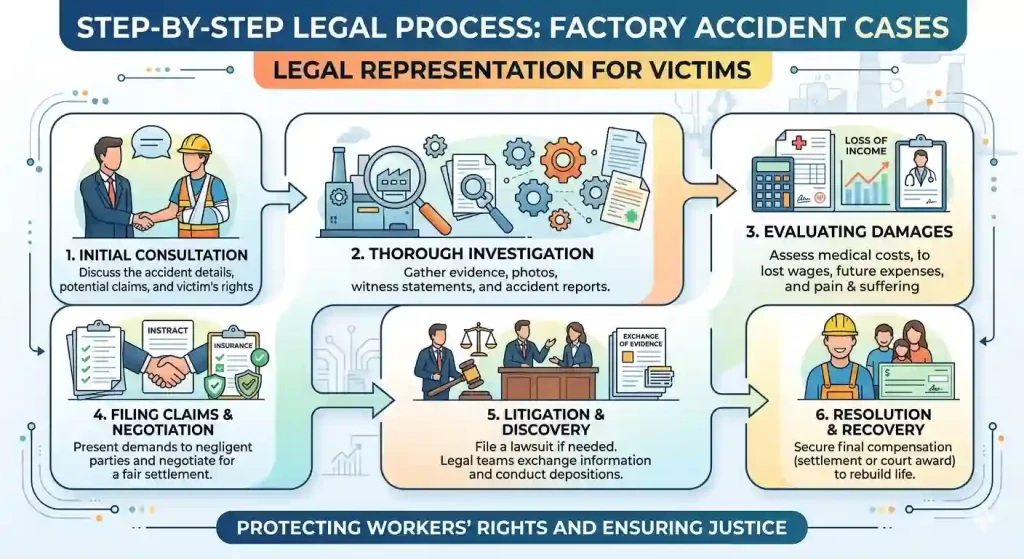
Statutory Framework Protecting Factory Workers: Key Laws and Provisions
India maintains a comprehensive statutory framework specifically protecting factory workers from industrial accidents. Therefore, understanding each applicable law empowers victims to assert their full legal rights. The Factories Act, 1948 imposes mandatory safety obligations on every factory owner and occupier. Furthermore, the Employees’ Compensation Act, 1923 (EC Act) guarantees statutory compensation for work-related injuries. Additionally, the Occupational Safety, Health and Working Conditions Code, 2020 (OSHWC Code) modernizes worker safety standards comprehensively. Consequently, violations of these statutes by factory management expose them to significant civil and criminal liability. Foundational statutes governing factory accident claims include:
- Factories Act, 1948 – Sections 7A, 11, 13, 14, 21, 23, 36, 87, 92
- Employees’ Compensation Act, 1923 – Sections 3, 4, 4A, 10, 22
- Occupational Safety, Health and Working Conditions Code, 2020
- Employees’ State Insurance Act, 1948 – Sections 46, 51, 52, 53
- Fatal Accidents Act, 1855 – For dependant death compensation claims
- Bharatiya Nyaya Sanhita, 2023 (BNS) – Sections 106, 125, 290, 304
- Workmen’s Compensation (Amendment) Act, 2009 – Enhanced compensation provisions
Moreover, the Environment Protection Act, 1986 addresses industrial accidents causing hazardous substance exposure. Consequently, chemical factory explosion victims may claim under multiple statutes simultaneously. Rajendra Civil Law Firm identifies every applicable statute before initiating legal proceedings for clients. Thus, our victims receive maximum possible relief from all available legal avenues without exception.
Types of Factory Accidents and Associated Legal Issues in India
Factory accidents occur in diverse forms, each generating distinct legal issues and liability questions. Therefore, accurately classifying the accident type determines the most effective legal strategy for victims. The following table categorizes common factory accident types and their key legal implications for injured workers:
| Accident Type | Primary Legal Issue | Applicable Law |
|---|---|---|
| Machinery entrapment injuries | Employer negligence, guard failure | Factories Act S.21, EC Act S.3 |
| Chemical or toxic gas exposure | Hazardous process liability | Factories Act S.87, EPA 1986 |
| Fire and explosion accidents | Absolute liability, safety breach | BNS S.304, Factories Act S.38 |
| Falls from height or scaffold | Structural negligence, safety failure | Factories Act S.32, EC Act |
| Electrical accidents | Inadequate insulation, employer fault | Factories Act S.36, EC Act |
| Boiler or pressure vessel explosion | Absolute liability, maintenance failure | Boilers Act, BNS S.290 |
| Fatal accidents at factory | Dependant compensation, criminal negligence | Fatal Accidents Act, BNS S.106 |
Additionally, repetitive strain injuries and occupational diseases qualify as compensable injuries under the EC Act. Consequently, long-term factory workers suffering silicosis, asbestosis, or hearing loss deserve full legal remedies. Rajendra Civil Law Firm handles every accident category with specialized expertise and proven strategy. Furthermore, our multi-statute approach ensures victims receive compensation from every legally available source simultaneously.
Jurisdiction and Competent Forums for Factory Accident Claims in India
Selecting the correct forum is strategically critical for maximizing and expediting factory accident compensation. Therefore, Rajendra Civil Law Firm conducts a thorough forum analysis before initiating any legal proceedings. The Employees’ Compensation Commissioner (ECC) adjudicates statutory compensation claims under the EC Act primarily. Furthermore, civil courts handle negligence-based tort claims for damages beyond statutory EC Act entitlements. Additionally, the National Green Tribunal (NGT) adjudicates factory accidents involving environmental pollution and hazardous waste. Consequently, complex factory accident matters often require simultaneous proceedings before multiple forums. Key adjudicatory forums for factory accident claims include:
- Employees’ Compensation Commissioner – District-level EC Act claims adjudication
- Civil Courts / High Court – Negligence tort suits for additional compensation
- Labour Court / Industrial Tribunal – Unfair termination after accident claims
- Employees’ State Insurance Court – ESI benefit disputes under ESI Act
- National Green Tribunal (NGT) – Chemical and hazardous factory accident claims
- National Consumer Disputes Redressal Commission – Insurance claim disputes
- High Court / Supreme Court – Constitutional remedies and writ petitions
Moreover, the Supreme Court’s absolute liability doctrine from M.C. Mehta v. Union of India (1987) strengthens hazardous industry victim claims. Therefore, victims of chemical and gas factory accidents enjoy strict liability compensation without proving negligence. Rajendra Civil Law Firm leverages the most advantageous forum for every client’s unique factual situation. Ultimately, strategic forum selection maximizes compensation recovery and minimizes delay for injured factory workers.
Comprehensive Legal Services by Rajendra Civil Law Firm for Factory Accident Victims
Employees’ Compensation Act Claims: Securing Statutory Compensation for Injured Workers
The Employees’ Compensation Act, 1923 guarantees statutory compensation to every injured factory worker. Therefore, filing a timely and well-prepared EC claim is the first essential step for every victim. Section 3 of the EC Act establishes employer liability for personal injuries arising during employment. Furthermore, Section 4 provides a detailed compensation formula based on injury severity and worker wages. Consequently, total disablement, partial disablement, and death each attract different statutory compensation calculations. Additionally, Section 4A mandates payment of interest at twelve percent per annum for delayed compensation. Our EC Act claim services for factory accident victims include:
- Calculating accurate statutory compensation under Section 4 formulas
- Filing Application under Section 22 before Employees’ Compensation Commissioner
- Collecting medical reports, injury certificates, and wage documentation
- Pursuing interest and penalty under Section 4A for employer payment delay
- Appealing EC Commissioner orders before High Court under Section 30
- Enforcing EC Commissioner awards against recalcitrant employers without delay
Moreover, the OSHWC Code, 2020 when fully implemented will enhance worker compensation entitlements further. Therefore, Rajendra Civil Law Firm monitors legislative developments to apply the most favorable provisions. Our advocates appear regularly before EC Commissioners across all jurisdictions in Tamil Nadu. Consequently, injured factory workers receive their full statutory compensation entitlement with maximum applicable interest.
Civil Negligence Suits: Claiming Full Damages Beyond Statutory Compensation Limits
Statutory EC Act compensation often falls short of the full damages suffered by factory accident victims. Therefore, civil negligence suits under the Code of Civil Procedure, 1908 (CPC) provide additional relief. Factory owners owe a non-delegable duty of care to every worker under established tort law principles. Furthermore, breach of the Factories Act safety provisions constitutes strong evidence of employer negligence in civil suits. Consequently, victims can claim compensation for pain, suffering, future loss of earnings, and medical expenses. Additionally, CPC Order 39 enables urgent interim injunctions to freeze employer assets pending trial. Our civil negligence litigation services for factory accident victims include:
- Filing comprehensive negligence suits before the District Court or High Court
- Claiming general and special damages including future medical care costs
- Seeking Attachment Before Judgment under CPC Order 38 Rule 5
- Expert witness engagement – industrial safety engineers and medical specialists
- Pursuing punitive damages for gross employer negligence and willful safety violations
- Enforcing civil court decrees through Order 21 execution proceedings
Moreover, the absolute liability principle applies to factories engaged in inherently dangerous activities. Therefore, chemical plant and gas factory victims need not prove negligence before civil courts. Rajendra Civil Law Firm combines EC Act claims with civil negligence suits for maximum recovery. Ultimately, our dual-track approach ensures factory accident victims receive comprehensive financial justice and accountability.
Criminal Prosecution Under BNS and BNSS for Factory Safety Violations
Factory accidents caused by employer negligence and safety violations attract serious criminal liability. Therefore, the Bharatiya Nyaya Sanhita, 2023 (BNS) provides powerful criminal remedies for factory accident victims. BNS Section 106 addresses death by negligent act with punishment up to five years imprisonment. Furthermore, Section 125 BNS criminalizes acts that endanger the life or safety of workers. Additionally, BNS Section 290 applies to factory acts causing public nuisance through hazardous processes. Consequently, factory owners and managers who violate safety norms face arrest and criminal prosecution. The Bharatiya Nagarik Suraksha Sanhita, 2023 (BNSS) governs criminal procedure for FIR filing and trial. Key police stations handling factory accident FIRs include:
- Industrial Area Police Stations – Ambattur, Guindy, Manali, SIPCOT areas
- Economic Offences Wing (EOW) – Commissioner’s Office, Chennai
- Central Crime Branch (CCB) – Vepery, Chennai
- CBCID Tamil Nadu – Inspector General’s Office, Chennai
- Local Police Stations – Sriperumbudur, Oragadam, Gummidipoondi Industrial Zones
Additionally, BNSS Section 173 enables Zero FIR at any police station regardless of territorial jurisdiction. Therefore, victims or families can file FIRs immediately without delay at the nearest station. Rajendra Civil Law Firm prepares comprehensive FIR applications and guides clients through BNSS proceedings. Consequently, criminal prosecution creates powerful deterrence, accountability, and supports parallel civil compensation claims.
ESI Benefits and Employer ESI Compliance Enforcement for Factory Workers
The Employees’ State Insurance (ESI) scheme provides crucial medical and cash benefits to injured factory workers. Therefore, ESI-registered workers must immediately activate their ESI entitlements following any factory accident. The ESI Act, 1948 under Section 46 provides sickness, disablement, dependant, and medical benefits comprehensively. Furthermore, Section 53 of the ESI Act bars ESI beneficiaries from receiving EC Act compensation simultaneously. Consequently, choosing between ESI benefits and EC Act compensation requires careful strategic legal analysis. Additionally, non-registration of eligible workers with ESIC by factory owners attracts criminal liability under the Act. Our ESI legal services for factory accident victims include:
- Verifying ESI coverage and registration status of the injured worker
- Filing ESI benefit claims before ESIC Regional Director, Chennai
- Challenging ESIC benefit denials before the ESI Court under Section 75
- Compelling unregistered employers to extend ESI coverage retrospectively
- Pursuing employer criminal liability for ESIC non-compliance under Section 85
- Advising on the EC Act vs. ESI benefit election strategy for maximum recovery
Moreover, the ESIC Regional Office for Tamil Nadu is located at Pattalam, Chennai. Therefore, our advocates regularly liaise with ESIC officials on behalf of injured worker clients. Rajendra Civil Law Firm advises every factory accident victim on optimal ESI and EC Act strategy. Ultimately, sound ESI legal guidance ensures workers receive maximum medical support and financial compensation throughout recovery.
Fatal Factory Accident Cases: Legal Remedies for Dependants and Families
Fatal factory accidents inflict irreparable loss on worker families and dependants left behind. Therefore, Rajendra Civil Law Firm provides urgent and compassionate legal support to bereaved families. The Fatal Accidents Act, 1855 entitles dependants to claim compensatory damages from negligent factory employers. Furthermore, EC Act Section 4(1)(a) prescribes a specific formula for calculating death compensation for dependants. Consequently, dependants including spouses, children, and parents file claims before the EC Commissioner. Additionally, BNS Section 106 enables criminal prosecution of factory owners for death by negligent act. Our fatal accident legal services for bereaved families include:
- Filing EC Act death compensation claims on behalf of legal dependants
- Fatal Accidents Act suits before civil courts for full tortious damages
- Criminal complaints under BNS Section 106 against factory owners and managers
- Claiming additional compensation under public liability insurance policies
- Assisting families with post-mortem report, FIR copy, and legal heir certificates
- Negotiating structured settlement agreements with factory insurance companies
Moreover, the Public Liability Insurance Act, 1991 mandates insurance coverage for hazardous factory accidents. Therefore, dependants of chemical plant explosion victims access additional compensation from public liability insurers. Rajendra Civil Law Firm manages the entire claims process on behalf of grieving families comprehensively. Consequently, bereaved dependants receive full financial justice without navigating complex legal proceedings alone.
Factories Act Inspection and Safety Violation Proceedings
The Factories Act, 1948 empowers government inspectors to enforce workplace safety standards rigorously. Therefore, triggering a Factory Inspector’s inspection following any accident creates critical documentary evidence. Section 7A of the Factories Act imposes a general duty on occupiers to ensure worker safety. Furthermore, Section 92 prescribes criminal penalties for Factories Act safety violations by factory management. Consequently, inspection findings provide powerful evidence in both civil compensation suits and criminal prosecutions. Additionally, the Chief Inspector of Factories, Tamil Nadu, headquartered in Chennai, oversees state-wide enforcement. Our Factory Inspector proceedings services include:
- Filing complaints before the Inspector of Factories for safety investigation
- Obtaining certified copies of Factory Inspector investigation reports
- Using inspection findings as evidence in EC Commissioner and civil court proceedings
- Monitoring prosecution proceedings under Section 92 initiated by the Inspector
- Filing private complaints before Magistrate for Factories Act violations
- Requesting Show Cause Notice issuance against errant factory occupiers
Moreover, the Directorate of Industrial Safety and Health (DISH), Tamil Nadu, maintains accident investigation records. Therefore, Rajendra Civil Law Firm obtains DISH accident investigation reports for litigation purposes. Our advocates work closely with Factory Inspectors to strengthen victim claims with official findings. Consequently, regulatory investigation evidence decisively establishes employer liability and maximizes compensation outcomes.
National Green Tribunal Claims for Chemical and Environmental Factory Accidents
Chemical factory explosions and toxic gas leaks cause both personal injury and environmental damage simultaneously. Therefore, the National Green Tribunal (NGT) provides a specialized forum for such complex accident claims. The NGT Act, 2010 under Section 15 enables compensation claims for environmental accident victims. Furthermore, the Environment Protection Act, 1986 establishes strict liability for hazardous substance factories causing harm. Consequently, NGT proceedings complement EC Act and civil court claims for chemical accident victims. Additionally, the Hazardous Waste (Management) Rules, 2016 impose factory storage and handling obligations for chemicals. Our NGT litigation services for factory chemical accident victims include:
- Filing Original Applications before NGT Southern Zone Bench, Chennai
- Claiming compensation under Section 15 NGT Act for personal and environmental injury
- Seeking factory closure or operational restrictions as interim relief
- Engaging environmental experts and toxicologists as expert witnesses
- Coordinating with Tamil Nadu Pollution Control Board (TNPCB) for evidence
Moreover, the NGT Southern Zone Bench is located at Bangalore but accepts filings from Tamil Nadu parties. Therefore, Rajendra Civil Law Firm files NGT applications and attends hearings on behalf of chemical accident victims. Our NGT practice team has deep expertise in environmental liability and hazardous process regulations. Consequently, chemical factory accident victims receive specialized, multi-forum legal representation delivering maximum compensation.
Evidence Collection Under Bharatiya Sakshya Adhiniyam for Factory Accident Litigation
The Bharatiya Sakshya Adhiniyam, 2023 (BSA) governs admissibility of all evidence in Indian court proceedings. Therefore, systematic evidence collection from the accident site is critically important for every factory accident claim. BSA Section 57 makes electronic records including CCTV footage, sensor logs, and digital reports fully admissible. Furthermore, Section 63 BSA requires a certificate to authenticate electronic records for court admissibility. Consequently, preserving digital workplace safety data from the accident scene becomes immediately urgent. Additionally, BSA Section 32 covers expert opinion evidence, enabling industrial safety engineers to testify effectively. Our evidence collection services for factory accident litigation include:
- Securing CCTV footage, sensor readings, and production logs from the accident site
- Collecting medical records, injury certificates, and disability assessment reports
- Obtaining Factory Inspector, DISH, and Pollution Control Board investigation reports
- Engaging industrial safety expert witnesses for technical evidence and testimony
- Preserving witness statements from co-workers and supervisors under BNSS norms
- Applying for Court Commissioner appointment to inspect and report on accident site
Moreover, BSA Section 16 governs relevance of facts showing motive, preparation, and prior negligence. Therefore, evidence of previous safety violations by the factory strengthens current accident liability claims. Rajendra Civil Law Firm builds comprehensive, court-ready evidence dossiers from the earliest stage. Consequently, powerful evidence preparation under BSA decisively improves compensation and criminal prosecution outcomes.
Labour Department Complaints and Factory Licence Suspension Proceedings
Factories Act safety violations warrant regulatory complaints to state Labour Department authorities. Therefore, filing Labour Department complaints creates official pressure on factory management immediately after accidents. The Commissioner of Labour, Tamil Nadu, headquartered in Chennai, oversees factory compliance enforcement statewide. Furthermore, the Inspector of Factories can recommend licence suspension or cancellation for serious safety breaches. Consequently, licence suspension proceedings create powerful negotiating leverage for factory accident victims. Additionally, the Labour Commissioner’s office issues show-cause notices compelling employers to address safety violations. Our Labour Department complaint services include:
- Filing written safety complaints before the Inspector of Factories, Tamil Nadu
- Petitioning the Chief Inspector of Factories for factory licence suspension
- Filing complaints before the Labour Commissioner for EC Act compliance failures
- Representing workers in Labour Department inquiry proceedings and hearings
- Monitoring and enforcing Labour Department directives against errant factories
- Pursuing criminal prosecution under Section 92 Factories Act through Labour authorities
Moreover, the OSHWC Code, 2020 strengthens worker rights to refuse dangerous work without employer retaliation. Therefore, workers who report safety violations gain statutory protection from dismissal and victimization. Rajendra Civil Law Firm coordinates Labour Department proceedings alongside civil and criminal litigation. Consequently, a simultaneous multi-authority approach generates maximum regulatory pressure on negligent factory employers.
Insurance Claims and Public Liability Compensation for Factory Accident Victims
Factory accident victims have rights against insurance policies covering employer liability and public liability. Therefore, identifying and claiming from all applicable insurance policies maximizes total financial recovery for victims. The Workmen’s Compensation Policy covers employer EC Act liability under mandatory insurance requirements. Furthermore, the Public Liability Insurance Act, 1991 mandates hazardous factory owners to carry public liability coverage. Consequently, chemical and hazardous factory accident victims can claim directly from public liability insurers. Additionally, Group Personal Accident (GPA) policies maintained by factories provide additional compensation to workers. Our factory accident insurance claim services include:
- Identifying all applicable insurance policies covering the factory accident
- Filing Workmen’s Compensation insurance claims on behalf of injured workers
- Claiming Public Liability Insurance compensation for hazardous factory accidents
- Challenging insurer denials before IRDAI Grievance Cell or Insurance Ombudsman
- Filing civil suits against insurers for wrongful claim repudiation
- Pursuing Group Personal Accident policy benefits for injured factory workers
Moreover, the Insurance Ombudsman for Tamil Nadu is located at Egmore, Chennai, providing accessible grievance redressal. Therefore, rejected insurance claimants receive free, fast, and effective redressal through the Ombudsman process. Rajendra Civil Law Firm handles all insurance claim documentation, negotiation, and dispute litigation. Consequently, factory accident victims maximize total financial recovery by claiming from every applicable insurance policy.
Mediation and Alternative Dispute Resolution for Factory Accident Settlements
Alternative dispute resolution offers factory accident victims faster and less costly compensation settlements. Therefore, the Mediation Act, 2023 enables structured, confidential mediation of factory accident compensation disputes. Many factory accident cases involve multiple parties including employers, insurers, and contractors simultaneously. Consequently, mediation effectively facilitates multi-party settlements that complex litigation often struggles to achieve. Furthermore, EC Commissioner-referred conciliation under Section 22 of the EC Act resolves disputes amicably. Additionally, settlements reached through mediation are enforceable as court decrees under Section 27 Mediation Act. Our ADR services for factory accident victims include:
- Representing injured workers in pre-litigation mediation under Mediation Act, 2023
- Participating in EC Commissioner conciliation proceedings under Section 22
- Negotiating structured settlement agreements with factory employers and insurers
- Enforcing mediated settlements as decrees before competent courts
- Advising victims on whether mediation or litigation better serves their interests
Moreover, Tamil Nadu Mediation and Conciliation Centre at the High Court of Madras provides institutional mediation. Therefore, Rajendra Civil Law Firm actively recommends mediation when it serves the victim’s best interests. Our trained mediator-advocates negotiate powerful settlements while preserving the client’s litigation rights. Consequently, factory accident victims through mediation receive faster compensation while avoiding prolonged courtroom uncertainty.
Government Departments and Regulatory Authorities for Factory Accident Redressal
Multiple government departments and regulatory authorities handle various aspects of factory accident redressal. Therefore, knowing the correct authority for each specific issue enables faster and more effective legal relief. Rajendra Civil Law Firm maintains active engagement with all key regulatory bodies handling factory accident matters. The following table identifies major authorities and their specific jurisdictions for factory accident victims:
| Authority | Function | Location |
|---|---|---|
| Chief Inspector of Factories, TN | Safety enforcement, licence regulation | Teynampet, Chennai |
| DISH Tamil Nadu | Industrial accident investigation | Guindy, Chennai |
| Commissioner of Labour, TN | EC Act, labour law compliance | Chepauk, Chennai |
| ESIC Regional Office, TN | ESI benefit claims and disputes | Pattalam, Chennai |
| NGT Southern Zone Bench | Environmental factory accident claims | Bangalore (TN filings) |
| Insurance Ombudsman, Chennai | Insurance claim grievance redressal | Egmore, Chennai |
| Tamil Nadu Pollution Control Board | Chemical accident investigation | Guindy, Chennai |
| Ministry of Labour and Employment | OSHWC Code, national labour policy | Shram Shakti Bhawan, Delhi |
Additionally, the Tamil Nadu State Legal Services Authority (TNSLSA) provides free legal aid to economically disadvantaged accident victims. Therefore, unrepresented factory accident victims can access Rajendra Civil Law Firm’s services through TNSLSA referral. Our advocates also conduct factory worker legal awareness programmes in industrial zones across Tamil Nadu. Consequently, informed workers assert their rights effectively and receive justice more promptly after workplace accidents.
Rehabilitation, Disability Certification, and Long-Term Worker Support Services
Factory accident injuries often produce long-term disability requiring sustained rehabilitation and legal protection. Therefore, Rajendra Civil Law Firm provides comprehensive post-accident legal support addressing long-term worker needs. The Rights of Persons with Disabilities Act, 2016 protects disabled factory accident victims from workplace discrimination. Furthermore, disability certification from a government medical authority is essential for maximizing EC Act compensation calculations. Consequently, obtaining accurate and comprehensive disability assessment reports significantly impacts total compensation amounts. Additionally, the National Trust Act, 1999 provides support mechanisms for severely disabled industrial accident victims. Our long-term rehabilitation legal support services include:
- Assisting in obtaining disability certificates from government medical boards
- Challenging inadequate disability assessments before medical boards and courts
- Claiming future medical care and rehabilitation costs in compensation suits
- Advising on RPWD Act protections against employment discrimination after accidents
- Pursuing employer obligations for workplace accommodation under RPWD Act 2016
- Accessing National Trust Act support schemes for severely disabled accident victims
Moreover, the Vocational Rehabilitation Centre (VRC) in Chennai assists disabled workers in skill retraining programmes. Therefore, Rajendra Civil Law Firm connects disabled accident victims with VRC and rehabilitation support services. Our holistic post-accident legal support ensures clients receive every available rehabilitation entitlement. Consequently, injured factory workers rebuild their lives with the fullest possible legal, financial, and rehabilitative support.
Writ Petitions and Constitutional Remedies for Systematic Factory Safety Failures
Systematic factory safety failures affecting multiple workers may warrant constitutional court intervention. Therefore, writ petitions before the High Court of Madras provide powerful remedies for large-scale safety violations. Article 21 of the Constitution guarantees the right to life with dignity, including safe workplace conditions. Furthermore, Article 226 empowers the High Court to issue writs against employers and regulatory authorities failing their duties. Consequently, public interest litigation (PIL) can compel government authorities to enforce factory safety standards. Additionally, directions for factory closure, enhanced inspection, and compensation can be issued through writ proceedings. Our writ petition and constitutional remedy services include:
- Filing Writ Petitions under Article 226 before the High Court of Madras
- Filing Public Interest Litigations for systematic factory safety enforcement
- Obtaining interim orders restraining dangerous factory operations
- Compelling government factory inspections through Mandamus petitions
- Seeking compensation through High Court for fundamental rights violations
- Appealing to Supreme Court under Article 136 for significant accident cases
Moreover, the High Court of Madras has consistently upheld worker safety rights in landmark industrial accident judgments. Therefore, Rajendra Civil Law Firm leverages strong constitutional precedents to advance every factory accident victim’s case. Our writ petition team is highly experienced in Article 21 worker rights litigation across Tamil Nadu. Consequently, constitutional remedies provide factory accident victims with the highest level of judicial protection available.
Why Rajendra Civil Law Firm Is the Premier Choice for Factory Accident Victims
Rajendra Civil Law Firm combines deep legal expertise with genuine dedication to every factory accident victim’s cause. Therefore, our clients receive powerful, multi-forum legal representation from experienced industrial accident advocates. Our team possesses specialized knowledge across EC Act, Factories Act, BNS, BNSS, BSA, CPC, and environmental laws. Consequently, we build comprehensive, multi-statute legal strategies that maximize compensation from every available legal source. Furthermore, we maintain established relationships with industrial safety experts, medical specialists, and forensic consultants. Therefore, our clients benefit from expert technical evidence that decisively supports their compensation and criminal prosecution claims. Our distinctive strengths for factory accident victim representation include:
- Deep expertise across EC Act, Factories Act, BNS, BNSS, BSA, ESI Act, RPWD Act
- Active representation before EC Commissioners, High Court of Madras, NGT, ESI Courts
- Proven track record in fatal accident, chemical exposure, and disability compensation claims
- Dedicated client communication with regular case progress updates and transparent advice
- Expert network of industrial safety engineers, toxicologists, and disability assessors
- Affordable, client-aligned fee structures including contingency arrangements for eligible victims
- Legal aid coordination for economically disadvantaged factory accident victims
- Free initial consultation for all factory accident victims and their families
Moreover, Rajendra Civil Law Firm conducts regular factory worker legal literacy programmes in industrial areas. Therefore, workers in Ambattur, Guindy, Sriperumbudur, and Oragadam industrial zones receive proactive legal education. Our unwavering commitment to worker justice drives every action we take on behalf of our clients. Consequently, Rajendra Civil Law Firm remains the most trusted and effective legal partner for factory accident victims throughout Tamil Nadu.
Frequently Asked Questions: Factory Accident Legal Rights in India
FAQ 1: What compensation does a factory accident victim receive under the EC Act?
EC Act Section 4 calculates compensation based on injury severity and monthly wages. Total disablement, partial disablement, and death attract different formula-based statutory compensation amounts.
FAQ 2: Can a factory accident victim claim both ESI benefits and EC Act compensation?
No. ESI Act Section 53 bars simultaneous ESI and EC Act claims. Workers must elect one remedy strategically. Prodigy Attorneys advises on maximizing recovery through the optimal choice.
FAQ 3: What criminal charges apply to factory owners after a fatal accident?
BNS Section 106 applies for death by negligent act. Factories Act Section 92 also attracts criminal penalties. FIRs can be filed at EOW Chennai or industrial area police stations immediately.
FAQ 4: Which forum handles chemical factory accident compensation claims in Tamil Nadu?
NGT Southern Zone Bench and civil courts handle chemical factory accident claims. Additionally, public liability insurance claims are filed separately. TNPCB investigations provide crucial supporting evidence.
FAQ 5: How does the Bharatiya Sakshya Adhiniyam help factory accident victims?
BSA Section 57 makes CCTV footage and digital workplace safety records admissible as evidence. A Section 63 BSA certificate authenticates electronic accident scene data before courts effectively.
FAQ 6: Can factory accident victims file a Zero FIR under BNSS?
Yes. BNSS Section 173 enables Zero FIR at any police station regardless of jurisdiction. This ensures immediate FIR registration without jurisdictional delays after serious factory accidents.
FAQ 7: What is the limitation period for factory accident compensation claims?
EC Act claims must be filed within two years of the accident date. Civil negligence suits have a three-year limitation under the Limitation Act. Early filing is therefore essential for victims.
FAQ 8: Can dependants of fatal factory accident victims claim compensation?
Yes. Dependants claim under EC Act Section 4, Fatal Accidents Act, and BNS Section 106. Additionally, public liability and workmen’s compensation insurance provide further financial relief to families.
FAQ 9: How can a Factory Inspector’s report help a compensation claim?
Factory Inspector reports establish official evidence of safety violations and accident causes. They strengthen EC Act claims, civil negligence suits, and BNS criminal prosecutions against factory owners.
FAQ 10: Does the OSHWC Code, 2020 change factory accident compensation rights?
Yes. The OSHWC Code, 2020 consolidates and enhances worker safety and compensation rights significantly. It expands coverage categories and strengthens employer safety obligations beyond the Factories Act.
Read More
- Execution of Decree: Ensuring Timely Enforcement of Judgments
- Expert Assistance for Eviction Orders: Protecting Your Rights
- Employment Disputes Resolved: Expert Legal Representation
- Declaration Suit: Your Path to Legal Clarity
- Pursuing Damage Suit Claims: Legal Expertise You Can Trust
- Ministry of Labour and Employment