
Winning a case in court is a major achievement. However, many people do not realize that getting a favorable judgment is only half the battle. The real challenge often begins after the judgment, when the decree must be enforced. This stage is known as the execution of decree.
Unfortunately, delays and complications in execution can prevent a successful party from enjoying the benefits of the judgment. Therefore, understanding the execution process is essential. In this article, Rajendra Civil Law Firm explains how execution works, common challenges, and practical ways to ensure timely enforcement.
Execution of Decree: Ensuring Timely Enforcement of Judgments – Rajendra Civil Law Firm
What Is a Decree?
A decree is the formal expression of a court’s decision in a civil case. It clearly states the rights of the parties and the relief granted.
For example, a decree may:
- Order payment of money
- Direct delivery of property
- Require specific performance of a contract
- Grant injunctions
Thus, a decree is legally binding and must be followed.
What Is Execution of a Decree?
Execution is the process by which the court ensures that its decree is carried out. In simple terms, it is the legal mechanism used to enforce a judgment.
If the losing party does not comply voluntarily, the winning party (decree-holder) can approach the court for execution.
Therefore, execution ensures that justice is not just declared but actually delivered.
Importance of Timely Execution
Timely execution is crucial for several reasons.
1. Realization of Rights
Without execution, the decree-holder cannot enjoy the benefits granted by the court.
2. Prevention of Delay Tactics
Delays may allow the judgment-debtor to avoid or weaken enforcement.
3. Maintenance of Legal Authority
Effective execution strengthens public confidence in the legal system.
Hence, timely enforcement is essential for justice.
Who Can File for Execution?
The following parties can initiate execution proceedings:
- The decree-holder
- A legal representative of the decree-holder
- An assignee of the decree
Thus, anyone legally entitled to the benefits of the decree can seek execution.
Where to File Execution Proceedings?
Execution proceedings are generally filed in:
- The court that passed the decree, or
- A court to which the decree is transferred
Therefore, jurisdiction depends on convenience and legal provisions.
Modes of Execution of Decree
The law provides various methods to enforce a decree.
1. Attachment and Sale of Property
The court may attach and sell the property of the judgment-debtor to recover money.
2. Arrest and Detention
In certain cases, the court may order arrest and detention of the debtor.
3. Garnishee Proceedings
The court may direct a third party to pay money owed to the debtor.
4. Delivery of Property
If the decree involves property, the court can ensure its delivery.
5. Appointment of Receiver
A receiver may be appointed to manage and recover assets.
Thus, multiple enforcement tools are available.
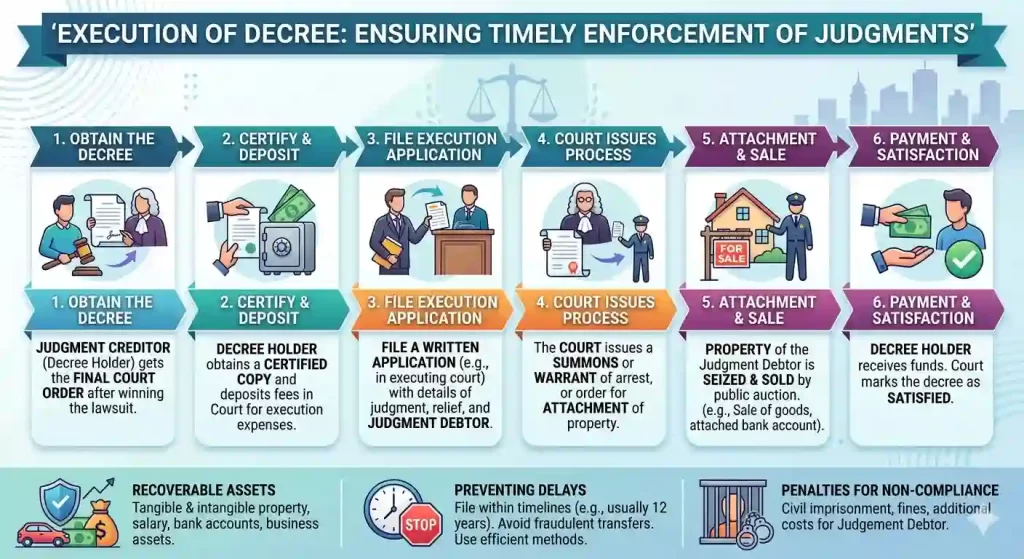
Step-by-Step Execution Process
Understanding the process helps in effective enforcement.
Step 1: Filing Execution Petition
The decree-holder files an execution petition with necessary details.
Step 2: Issuance of Notice
The court may issue notice to the judgment-debtor.
Step 3: Hearing
Both parties are heard regarding the execution request.
Step 4: Court Order
The court passes appropriate orders for execution.
Step 5: Enforcement Action
Authorities carry out the court’s directions.
Therefore, a structured process ensures fairness.
Time Limit for Execution
Execution must be initiated within the limitation period prescribed by law, generally 12 years from the date of the decree.
However, delays should be avoided because:
- Evidence may become difficult to gather
- Assets may be transferred or hidden
Thus, timely action is critical.
Common Challenges in Execution
Despite clear laws, execution often faces hurdles.
1. Delay by Judgment-Debtor
Debtors may use legal tactics to delay enforcement.
2. Hidden Assets
Identifying the debtor’s assets can be difficult.
3. Procedural Complexity
Execution involves multiple legal steps.
4. Lack of Awareness
Many decree-holders are unaware of their rights.
However, proper legal guidance can overcome these challenges.
Role of Lawyers in Execution Proceedings
Legal experts play a vital role in ensuring effective execution.
They assist in:
- Drafting execution petitions
- Identifying assets of the debtor
- Representing clients in court
- Handling objections and delays
At Rajendra Civil Law Firm, we focus on quick and efficient enforcement strategies.
Strategies for Faster Execution
To ensure timely enforcement, certain strategies can be adopted.
1. Immediate Filing
Do not delay filing the execution petition.
2. Asset Identification
Gather information about the debtor’s assets early.
3. Use of Multiple Modes
Apply different execution methods simultaneously where possible.
4. Continuous Follow-Up
Regularly monitor the progress of the case.
Thus, proactive steps can significantly reduce delays.
Handling Objections by Judgment-Debtor
Judgment-debtors often raise objections to delay execution.
Common objections include:
- Disputes about decree validity
- Claims of payment
- Technical objections
Courts examine these objections carefully. Therefore, strong legal representation is essential to counter them.
Role of Courts in Ensuring Enforcement
Courts play a key role in execution.
They:
- Ensure compliance with decrees
- Prevent misuse of legal process
- Pass necessary enforcement orders
Thus, courts act as guardians of justice even after judgment.
Importance of Documentation
Proper documentation strengthens execution proceedings.
Essential documents include:
- Certified copy of the decree
- Court orders
- Records of previous proceedings
- Proof of non-compliance
Therefore, maintaining accurate records is crucial.
Impact of Non-Execution
Failure to execute a decree can have serious consequences.
- Loss of legal rights
- Financial losses
- Frustration and delay
Hence, execution should never be ignored.
Alternative Approaches
In some cases, parties may choose alternative methods.
1. Settlement
Negotiating a settlement can save time and cost.
2. Mediation
Neutral mediation can help resolve disputes amicably.
However, these options depend on the willingness of both parties.
Why Choose Rajendra Civil Law Firm?
At Rajendra Civil Law Firm, we understand that enforcement is as important as winning a case.
Our Strengths:
- Experienced civil litigation team
- Strong execution strategies
- Quick and effective action
- Client-focused approach
- Transparent communication
Moreover, we ensure that our clients receive the full benefit of their legal victories.
Future Trends in Execution Law
The legal system is evolving to improve execution processes.
In the future:
- Digital tracking of cases will increase
- Faster enforcement mechanisms will develop
- Greater accountability will be ensured
Therefore, execution proceedings are expected to become more efficient.
Frequently Asked Questions
Execution of a decree is the legal process by which a court ensures that its judgment is implemented. It allows the decree-holder to enforce the rights granted by the court when the judgment-debtor does not comply voluntarily. It is the final step in a civil case.
The decree-holder, their legal representative, or an assignee of the decree can file for execution. The application is made before the court that passed the decree or a competent court where execution is transferred for enforcement purposes.
Courts use several methods such as attachment and sale of property, arrest and detention of the judgment-debtor, garnishee orders, delivery of property, and appointment of a receiver. The court selects the appropriate method based on the nature of the decree and circumstances.
Generally, the limitation period for filing execution is 12 years from the date of the decree. However, delay can create practical difficulties such as loss of evidence or disposal of assets, so early execution is always recommended.
Common challenges include delay tactics by the judgment-debtor, difficulty in identifying assets, procedural complexities, and filing of objections. These issues can slow down enforcement. However, with proper legal assistance, courts can overcome these hurdles and ensure timely execution. Strong documentation, continuous follow-up, and effective legal strategy also play an important role in achieving successful enforcement of judgments in civil cases.
Conclusion
Execution of a decree is a crucial stage in the legal process. Without it, a favorable judgment has little practical value. Therefore, timely and effective execution is essential to ensure justice.
You can overcome these challenges with proper planning, legal expertise, and proactive action. By understanding the process and taking the right steps, decree-holders can secure their rights without unnecessary delay.
Rajendra Civil Law Firm efficiently enforces judgments for our clients. Our expertise and dedication ensure that we deliver justice promptly, not just declare it.
Read More
- Expert Assistance for Eviction Orders: Protecting Your Rights
- Employment Disputes Resolved: Expert Legal Representation
- Declaration Suit: Your Path to Legal Clarity
- Pursuing Damage Suit Claims: Legal Expertise You Can Trust
- Navigating Customs, Excise, and Service Tax Appellate Tribunal (CESTAT)
- Supreme Court of India