
Legal disputes often begin with confusion. Sometimes, you do not want money. You do not want punishment. Instead, you simply want the court to officially declare your legal right. In such situations, a Declaration Suit becomes your strongest tool. At Rajendra Civil Law Firm: Best Civil Advocates, we help clients seek clarity, protect their rights, and prevent future disputes through well-planned declaration suits. Let us understand what a declaration suit means, when you should file it, and how it can protect your future.
Declaration Suit: Your Path to Legal Clarity – Rajendra Civil Law Firm
What is a Declaration Suit?
A declaration suit is a civil case where a person approaches the court to declare their legal status or right. In simple words, you ask the court to confirm that you have a specific legal right over property, status, or relationship.
The legal basis for declaration suits in India is found under Section 34 of the Specific Relief Act, 1963. This provision allows a person to file a suit when their legal character or property right is denied or challenged by another person.
For example, if someone falsely claims ownership over your land, you can file a declaration suit to declare that you are the lawful owner. Once the court passes a decree, your right becomes legally recognized.
Why is a Declaration Suit Important?
Very often, disputes arise due to unclear ownership, false documents, or competing claims. Therefore, instead of waiting for the other party to take action, you can approach the court first.
A declaration suit offers several benefits:
- It confirms your legal right.
- It prevents future litigation.
- It strengthens your position in related cases.
- It clears confusion in revenue and property records.
Most importantly, it brings peace of mind. Once the court declares your right, the dispute becomes legally settled.
Situations Where You Can File a Declaration Suit
Now, let us look at common situations where declaration suits are useful.
1. Property Ownership Disputes
Property disputes are very common in India. For instance, someone may falsely claim ownership, question your title, or rely on forged documents. In such cases, you can file a declaration suit to declare your ownership.
Sometimes, these disputes arise due to inheritance issues governed by laws like the Hindu Succession Act, 1956. When legal heirs disagree over shares, a declaration suit helps determine rightful ownership.
2. Invalid or Fraudulent Documents
If someone creates a fake sale deed, gift deed, or settlement deed affecting your rights, you can seek a declaration that such document is invalid and not binding on you.
3. Legal Status or Character
In certain cases, a person may seek declaration regarding marital status, adoption rights, or legitimacy. For example, a person may ask the court to declare that a marriage is void or that they are a lawful heir.
4. Easement and Usage Rights
Disputes regarding pathway rights, water usage, or access to common areas often require a declaration from the court to confirm legal entitlement.
Legal Requirements for Filing a Declaration Suit
Although declaration suits are powerful, the law sets certain conditions. Under Section 34 of the Specific Relief Act:
- The plaintiff must have a legal character or right to property.
- The defendant must deny or threaten to deny that right.
- The plaintiff must not be able to seek further relief that they have intentionally omitted.
Therefore, you must clearly prove that your right is under challenge. Courts will not grant declarations for imaginary or theoretical disputes.
Jurisdiction: Where to File the Suit?
A declaration suit must be filed in the appropriate civil court based on:
- The value of the property.
- The location of the property.
- The pecuniary limits of the court.
For example, property-related suits are usually filed where the property is located. Our experienced team at Rajendra Civil Law Firm: Best Civil Advocates carefully evaluates jurisdiction before filing the case to avoid technical rejection.
Documents Required for a Declaration Suit
To succeed in a declaration suit, strong documentation is essential. Common documents include:
- Title deeds (Sale Deed, Gift Deed, Settlement Deed)
- Encumbrance Certificate
- Patta or Revenue Records
- Tax receipts
- Identity proof
- Legal heir certificate (if inheritance is involved)
In addition, witness statements and supporting evidence strengthen your case.
Court Procedure in a Declaration Suit
Let us now understand the step-by-step process.
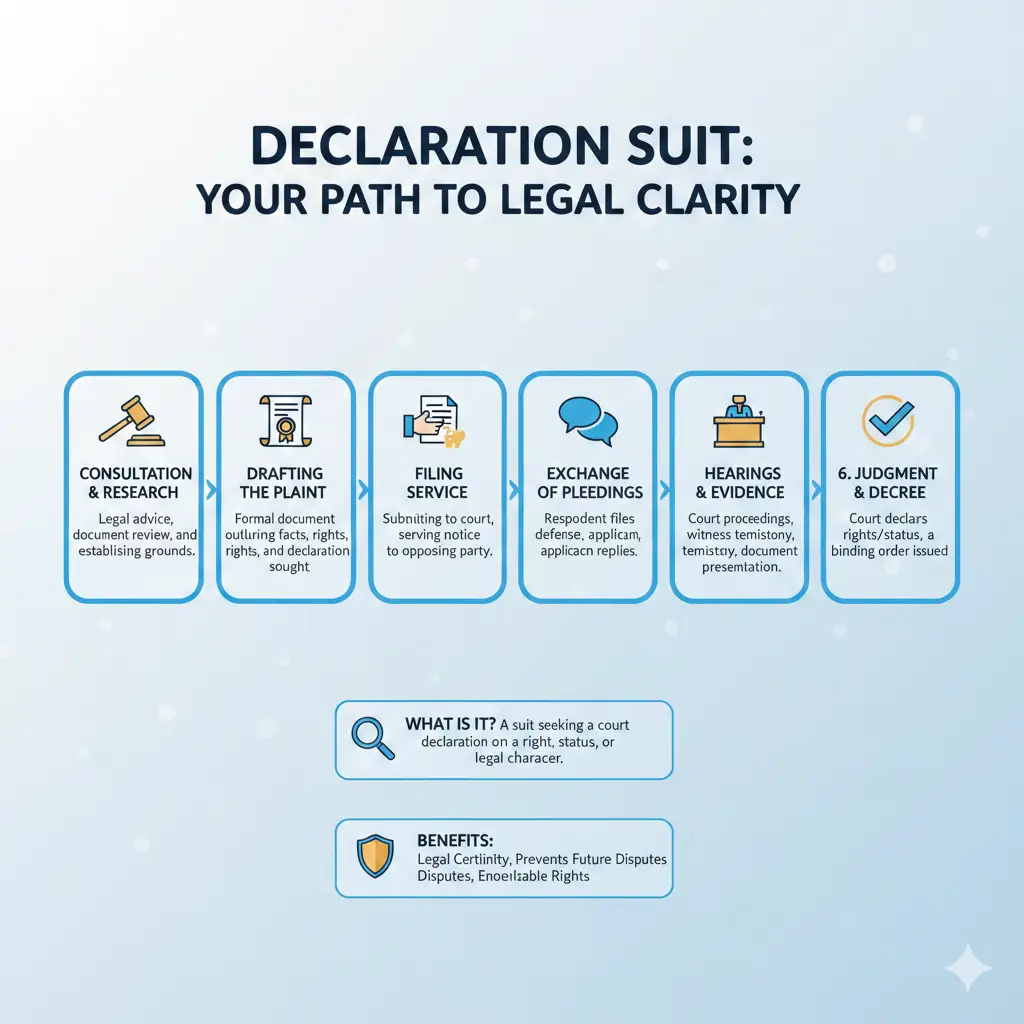
Step 1: Drafting and Filing the Plaint
First, your advocate drafts a detailed plaint explaining:
- Your legal right
- How the defendant denied your right
- The relief sought (declaration)
After that, the suit is filed before the appropriate civil court.
Step 2: Issue of Summons
The court sends summons to the defendant, asking them to appear and file a written statement.
Step 3: Written Statement
The defendant responds by accepting or denying your claims.
Step 4: Framing of Issues
The court identifies key questions that need to be decided.
Step 5: Evidence Stage
Both parties submit documents and examine witnesses.
Step 6: Arguments and Judgment
Finally, after hearing both sides, the court delivers its judgment and passes a decree.
Can You Seek Additional Relief Along with Declaration?
Yes, and this is very important.
Often, a declaration suit is combined with other reliefs such as:
- Permanent injunction
- Cancellation of documents
- Recovery of possession
For example, if someone occupies your land illegally, you can seek declaration of ownership and recovery of possession together. Filing combined relief prevents multiple litigations and saves time.
Limitation Period for Declaration Suit
Every civil suit must be filed within a specific time. Under the Limitation Act, 1963, the limitation period for declaration suits is generally three years from the date when the right to sue arises.
Therefore, it is important not to delay. If you wait too long, your claim may become legally barred.
Common Mistakes to Avoid
Although declaration suits seem simple, mistakes can weaken your case. Avoid the following:
- Filing in the wrong court.
- Omitting necessary parties.
- Not seeking consequential relief.
- Filing after limitation period.
- Submitting incomplete documents.
At Rajendra Civil Law Firm: Best Civil Advocates, we ensure that every technical requirement is fulfilled before filing the suit.
Importance of Skilled Legal Representation
Civil litigation requires strategy. Even a small drafting error can lead to dismissal. Therefore, professional legal guidance is essential.
A skilled civil advocate will:
- Study property records carefully.
- Identify legal weaknesses.
- Draft clear and precise pleadings.
- Present strong oral arguments.
- Handle cross-examination effectively.
With proper representation, your chances of success increase significantly.
How a Declaration Decree Protects You
Once the court grants a declaration:
- Your right becomes legally confirmed.
- Revenue authorities can update records.
- Opposite parties cannot legally challenge the same issue again.
- You gain stronger standing in future transactions.
In property matters, this decree becomes a powerful legal shield.
Declaration Suit vs. Injunction Suit
Many clients ask about the difference.
A declaration suit confirms a legal right.
An injunction suit prevents someone from doing something.
However, in many cases, both are filed together. For example, you may seek declaration of ownership and an injunction restraining the defendant from interfering with your possession.
Understanding this distinction is crucial before filing the case.
Time Duration of a Declaration Suit
Civil cases take time, depending on:
- Complexity of facts
- Number of witnesses
- Court workload
- Cooperation of parties
Although delays are common, proper documentation and effective advocacy can speed up the process.
Why Choose Rajendra Civil Law Firm: Best Civil Advocates?
At Rajendra Civil Law Firm: Best Civil Advocates, we believe in clarity, preparation, and strategy.
We provide:
- Detailed case analysis
- Honest legal advice
- Transparent communication
- Strong courtroom representation
- Timely updates
Most importantly, we treat every case with personal attention. We understand that property and legal status matters affect your family’s future. Therefore, we fight for your rights with dedication and professionalism.
Frequently Asked Questions
A declaration suit is a civil case filed to obtain a court’s official declaration about your legal right or status. You should file it when someone denies or threatens to deny your ownership, inheritance right, marital status, or other legal character. Under Section 34 of the Specific Relief Act, 1963, courts can declare your rights if you show a genuine dispute. Filing early helps prevent future litigation and protects your legal position.
Yes, you can. In many cases, courts expect you to seek additional relief if necessary. For example, along with declaration of ownership, you may seek permanent injunction to stop interference or recovery of possession if someone occupies your property. If you omit necessary relief, the court may dismiss the suit. Therefore, proper drafting is essential.
Important documents include title deeds, sale deeds, encumbrance certificates, revenue records, tax receipts, and identity proof. In inheritance matters, legal heir certificates may be required. Strong documentary evidence increases your chances of success.
Under the Limitation Act, 1963, the limitation period is generally three years from the date your right is denied. Delaying beyond this period may result in dismissal of your case.
The duration depends on the complexity of the dispute, evidence, number of witnesses, and court workload. Although civil cases may take time, proper preparation and skilled legal representation can help in faster resolution.
Final Thoughts: Secure Your Rights Before It Is Too Late
Legal uncertainty creates stress. However, the law gives you a clear solution through a declaration suit. Instead of waiting for disputes to grow, you can act confidently and seek judicial clarity. If someone denies your ownership, questions your status, or relies on invalid documents, do not remain silent. Take legal action at the right time. A declaration suit is not just a legal case. It is your path to certainty, protection, and peace of mind. At Rajendra Civil Law Firm: Best Civil Advocates, we stand ready to guide you through every step of the process. When your rights matter, clarity matters even more. Let us help you secure both.
Read More
- Pursuing Damage Suit Claims: Legal Expertise You Can Trust
- Navigating Customs, Excise, and Service Tax Appellate Tribunal (CESTAT)
- Mastering Corporate Laws: Your Comprehensive Guide
- FC-GPR Filing Services for Startups & Investors – Quick & Error-Free
- RBI & FEMA Compliance Specialists: Legal Services for Foreign Investments and International Payments
- National Government Services – Ministry of Law and Justice services