

Are you in a situation where you feel wronged and have not received your mortgage dues? Are you not getting proper service from your mortgage company? You likely need the legal assistance of an experienced Real Estate Disputes Lawyer in Chennai. Skilled property attorneys work across courtrooms throughout India. A good Property Attorney can help protect your rights when dealing with lenders. Rajendra Civil Law Firm offers top-ranked legal support for real estate disputes. These include matters related to Land Tort, buildings, and industrial properties. We cover commercial, residential, and mixed-use property disputes across Tamil Nadu. Learn how we deliver expert guidance for Resolving Real Estate Disputes in Chennai through skilled legal representation.
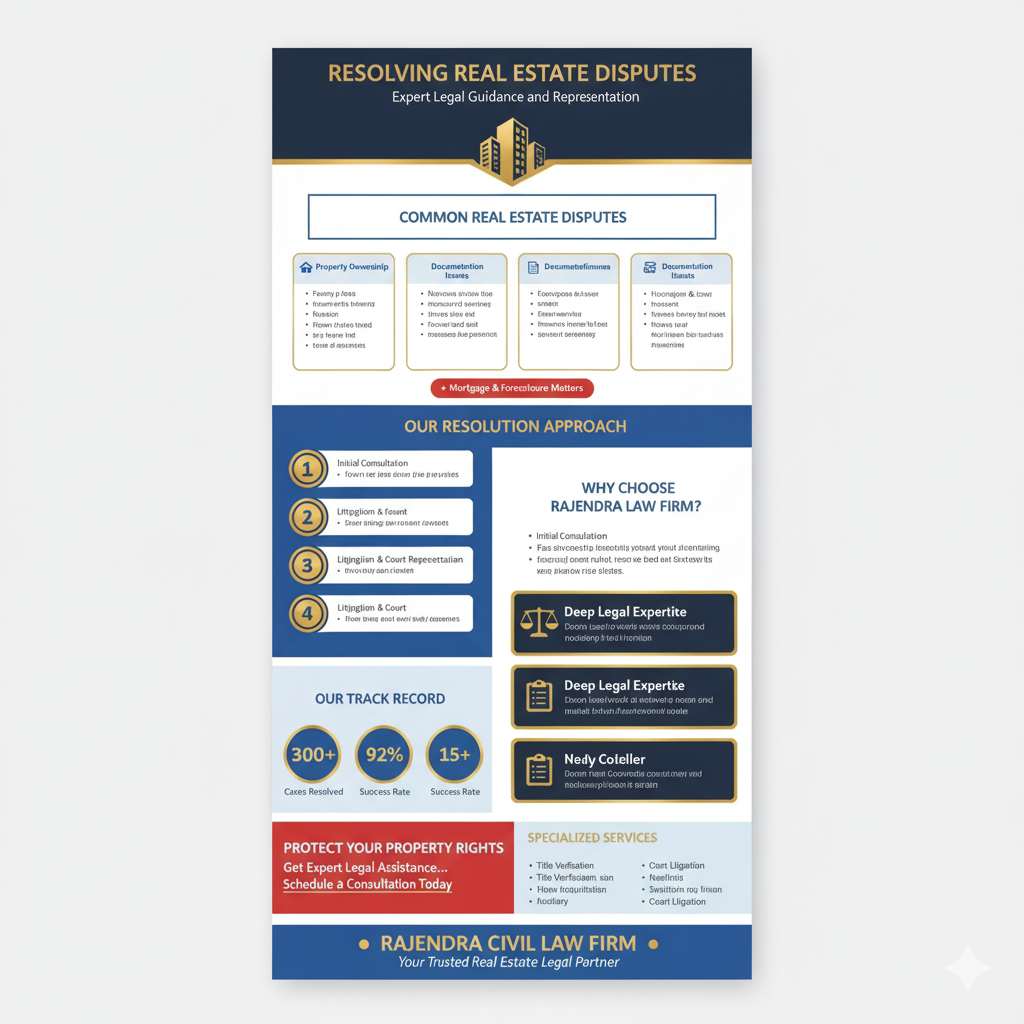
Understanding Real Estate Disputes in India: A Legal Overview
Real estate disputes are among the most complex civil legal matters in India. Therefore, understanding their nature is essential for every property owner. These disputes involve ownership conflicts, encroachment, fraudulent transfers, and breach of sale agreements. The Transfer of Property Act, 1882, the Registration Act, 1908, and the Specific Relief Act, 1963 govern most property-related matters. Courts frequently apply these laws to resolve competing claims. Additionally, the Bharatiya Nyaya Sanhita (BNS), 2023 now addresses property-related criminal offences, replacing the IPC. The Bharatiya Nagarik Suraksha Sanhita (BNSS), 2023 governs criminal procedure for such matters. Police stations in Chennai such as Mogappair, Anna Nagar, and Egmore handle property-related FIRs. Civil courts at the district level hear title suits and injunction applications. Accordingly, knowing the right forum is crucial before initiating any legal action in Chennai.
Types of Real Estate Disputes Handled by Property Lawyers in Chennai
Property lawyers in Chennai handle a wide variety of disputes across residential, commercial, and industrial sectors. Consequently, clients benefit from focused expertise in each dispute category. The following are major types of real estate disputes commonly addressed:
- Title and Ownership Disputes: Conflicting claims over legal ownership of land or buildings.
- Boundary and Encroachment Disputes: Unlawful occupation or encroachment of adjacent land.
- Builder-Buyer Disputes: Delays, defects, or non-delivery of possession under RERA.
- Landlord-Tenant Conflicts: Eviction, rent arrears, and lease violations under the Tamil Nadu Buildings (Lease and Rent Control) Act.
- Partition Suits: Division of jointly owned family or co-owned property.
- Fraudulent Property Transfers: Forgery of sale deeds or power of attorney misuse.
- Mortgage and Foreclosure Disputes: Non-payment issues and bank recovery actions under SARFAESI Act, 2002.
- Land Acquisition Disputes: Compensation claims under the LARR Act, 2013.
Furthermore, disputes involving negligence by contractors, developers, or realtors frequently come before civil courts. These matters demand strategic legal intervention from the outset. A skilled civil property lawyer identifies the right cause of action quickly. Moreover, legal counsel ensures that evidence is preserved and timelines are met.
Applicable Laws and Forums for Real Estate Disputes in Tamil Nadu
Navigating real estate disputes requires precise knowledge of applicable statutes and forums. Therefore, clients must approach matters with legal guidance at every stage. Below is a structured overview of key laws and corresponding forums:
| Legal Issue | Applicable Law | Forum / Authority |
|---|---|---|
| Title Dispute | Transfer of Property Act, 1882; Specific Relief Act, 1963 | Civil Court / District Court, Chennai |
| Builder Delay / Non-Delivery | RERA Act, 2016 | Tamil Nadu RERA Authority |
| Landlord-Tenant Conflict | TN Buildings (Lease & Rent Control) Act, 1960 | Rent Control Court, Chennai |
| Mortgage / Foreclosure | SARFAESI Act, 2002; Transfer of Property Act | Debt Recovery Tribunal (DRT), Chennai |
| Land Acquisition Compensation | LARR Act, 2013 | Land Acquisition Collector; High Court |
| Property Fraud / Forgery | BNS, 2023 (Sections 316–319); Registration Act | Police Station; CBI; Sessions Court |
| Consumer Grievances (Builder) | Consumer Protection Act, 2019 | District / State Consumer Commission |
| Encroachment | CPC Order 39; Specific Relief Act | Civil Court; Revenue Tribunal |
Additionally, the Madras High Court exercises supervisory jurisdiction over all subordinate civil courts. Writ petitions under Article 226 of the Constitution are filed there for government land matters. Revenue courts and Tahsildar offices also address patta and chitta disputes. Accordingly, choosing the right forum saves time and resources for the client.
Role of RERA in Resolving Builder-Buyer Disputes Effectively
The Real Estate (Regulation and Development) Act, 2016 (RERA) revolutionised property dispute resolution in India. Builders must now register all projects with Tamil Nadu RERA before marketing. Buyers gain significant legal protection against delays and defective construction. Moreover, RERA mandates transparency in project disclosures and fund utilisation. The TNRERA Authority in Chennai adjudicates complaints against registered developers. Complainants can seek refunds, compensation, and interest for delayed possession. Additionally, RERA’s appellate tribunal offers a faster remedy than conventional civil courts. Builders who violate RERA orders face penalties up to 10% of project cost. Furthermore, repeat violations can lead to imprisonment under Section 63 of the Act. Homebuyers across West Mogappair, Porur, and Ambattur have benefited from RERA proceedings. Therefore, every buyer must approach TNRERA before seeking civil court relief. Rajendra Civil Law Firm assists clients at every stage of the RERA complaint process effectively.
Property Lawyers in Chennai: Expertise, Investigation, and Legal Strategy
Not only foreclosure suits against mortgage companies but real property disputes involve diverse legal issues. These matters include realtor fraud, negligence, and deliberate concealment of material facts. Disputes may also arise from a contractor or remodelling company’s defective work. Failing to remit mortgage payments on time creates legal complications for borrowers. Additionally, banks sometimes fail to inform buyers of pending foreclosure actions. Providing incorrect information to a homeowner compounds their legal vulnerability significantly. These and many more situations require the expertise of property lawyers in Chennai. They must know state-specific laws and foreclosure procedures thoroughly. Handling financial legal issues arising during foreclosure proceedings also demands specialised competence. Therefore, engaging a skilled property advocate from the very beginning protects your interests strongly.
Find the Best Real Estate Disputes Lawyers in Chennai
Although you have rights under various laws, hiring the best Real Estate Disputes Lawyer is essential. An expert lawyer knows the legal system and handles mortgage companies and foreclosure proceedings efficiently. You do not want your home taken away without understanding local laws and regulations.
A competent advocate knows foreclosure law thoroughly and applies jurisdiction-specific statutes strategically. Furthermore, they understand the entire legal process and help you avoid procedural errors. When you hire the right lawyer early, you save both time and money. Therefore, research thoroughly and compare credentials before engaging legal counsel. Look for experience in both RERA matters and civil litigation. Check prior case outcomes and client testimonials to gauge competence. Advocates from Rajendra Civil Law Firm bring proven expertise in Chennai’s real estate courts. Additionally, they maintain familiarity with forums including District Courts, DRT, and TNRERA. Choosing wisely at the outset can determine the outcome of your entire dispute.

How Property Attorneys Investigate and Build Your Case
A thorough investigation is the foundation of any successful real estate dispute case. Therefore, a skilled Property Attorney examines all documents, records, and timelines meticulously. They scrutinise mortgage company records and interview relevant parties for factual clarity. Disbursement timelines and payment records are examined to identify legal breaches. All correspondence received from mortgage or registration agencies is analysed carefully. Moreover, property title documents, encumbrance certificates, and patta records are verified thoroughly. The Bharatiya Sakshya Adhiniyam (BSA), 2023 now governs evidentiary standards in civil proceedings. Digital records and electronic communications are admissible as evidence under BSA provisions. Consequently, attorneys ensure that digital correspondence, SMS records, and emails are properly preserved. Additionally, field inspections and survey reports are commissioned when boundary disputes arise. Revenue records from the Sub-Registrar’s Office and CMDA records are obtained systematically. This comprehensive approach ensures that no material fact is overlooked during litigation preparation.
Government Departments Involved in Chennai Real Estate Disputes
Real estate disputes in Chennai involve several government departments, each with a distinct role. Knowing which department handles what issue prevents procedural delays significantly. The following departments are frequently involved in property matters:
- Sub-Registrar’s Office (SRO): Registers sale deeds, gift deeds, and mortgages under the Registration Act, 1908.
- Revenue Department / Tahsildar’s Office: Issues patta, chitta, and adangal records for land ownership verification.
- Chennai Metropolitan Development Authority (CMDA): Regulates building plan approvals and land use in Greater Chennai.
- Tamil Nadu Housing Board (TNHB): Handles disputes involving government housing allotments and plot cancellations.
- Tamil Nadu RERA Authority: Adjudicates builder-buyer complaints and regulates project registrations.
- District Collectorate: Oversees land acquisition proceedings and revenue dispute appeals.
- Greater Chennai Corporation (GCC): Issues building occupancy certificates and addresses structure-related civic disputes.
- Tamil Nadu Slum Clearance Board: Deals with disputes involving slum lands and relocation entitlements.
Furthermore, police stations such as Mogappair, Anna Nagar West, Ambattur, and Tiruvallur handle FIRs under BNS for property fraud. The Economic Offences Wing (EOW) of Tamil Nadu Police investigates large-scale real estate fraud. Therefore, simultaneous civil and criminal proceedings are often necessary in complex cases.
Property Attorney Fees and Cost Transparency at Rajendra Civil Law Firm
The fees charged by real estate dispute lawyers typically depend on case complexity and monetary value. If the case is small and straightforward, legal fees are proportionately lower. Larger or more complex disputes involving multiple parties attract higher professional charges. Moreover, some advocates charge a fixed retainer while others prefer success-linked fees.
Transparency in fee structures is a hallmark of a trustworthy legal firm. Therefore, always request a written fee agreement before retaining any legal counsel. Compare credentials, experience, and fee structures across multiple firms diligently. Additionally, consider the lawyer’s familiarity with local courts and specific property laws. Rajendra Civil Law Firm provides clear, upfront fee disclosures to all clients. Furthermore, initial consultations help clients understand the likely cost before committing. Cost clarity at the beginning prevents misunderstandings throughout the legal process. Consequently, clients can focus on the legal strategy rather than financial uncertainty.
Contact a Top-Ranking Property Attorney in Chennai Today
It is important to find and contact a top-ranking property attorney in Chennai without delay. A good lawyer listens carefully and reviews all documents thoroughly before advising. They treat every client with respect, honesty, and professional integrity at all times. Confirm that the attorney’s approach aligns with your goals and expectations clearly. Furthermore, a reliable advocate communicates progress at every stage of the proceedings.
At Rajendra Civil Law Firm, every client receives personalised attention and dedicated support. Advocates here appear before the Madras High Court, District Courts, DRT, TNRERA, and Consumer Commissions. Additionally, they represent clients in arbitration and mediation proceedings under the Arbitration and Conciliation Act, 1996. Therefore, reach out today and schedule your consultation with an experienced property law expert. Acting promptly protects your rights and prevents irreversible legal harm effectively.
Legal Remedies and Dispute Resolution Strategies for Real Estate Matters
Multiple legal remedies exist for real estate disputes under Indian law. Consequently, the right remedy depends on the nature of the dispute and the relief sought. Choosing the correct legal pathway at the outset determines the speed and success of resolution. Therefore, expert legal guidance is indispensable before approaching any forum. Below is a comprehensive overview of available legal remedies across various dispute categories.
Rajendra Civil Law Firm’s advocates assess each case holistically to recommend the most effective remedy. Furthermore, they combine civil and criminal strategies where the facts demand dual-track litigation. Mediation and arbitration are encouraged when they offer faster, cost-effective resolutions. Additionally, interim relief such as injunctions prevents irreversible harm during ongoing proceedings. Moreover, declaratory suits establish legal title and quiet possession in court. Understanding available remedies empowers property owners to make informed legal decisions confidently. Let us explore each remedy category in detail for better clarity.
Civil Remedies Under CPC and the Specific Relief Act for Property Owners
The Code of Civil Procedure, 1908 (CPC) provides a robust framework for civil property remedies. Therefore, most property disputes begin with a civil suit filed under CPC provisions. Order 39 of the CPC allows courts to grant temporary injunctions against encroachment or alienation. Permanent injunctions under the Specific Relief Act, 1963 prevent recurring interference with property rights. Declaratory suits under Section 34 of the Specific Relief Act establish legal title definitively. Furthermore, suits for specific performance compel builders or sellers to honour sale agreements. Possession suits under Order 21 of the CPC recover physical possession of disputed property.
Additionally, mandatory injunctions can require parties to restore property to its original condition. The Specific Relief (Amendment) Act, 2018 made specific performance a rule rather than an exception. Consequently, courts are now more willing to enforce contracts rather than award damages alone. Moreover, mesne profits claims recover compensation for wrongful occupation of property over time.
Criminal Remedies Under BNS and BNSS for Property Fraud in Chennai
Property fraud is now addressed more effectively under the Bharatiya Nyaya Sanhita (BNS), 2023. Therefore, victims of forged sale deeds or impersonation can file FIRs at local police stations immediately. BNS Section 316 addresses cheating and fraudulent inducement in property transactions directly. Furthermore, forgery of property documents attracts stringent penalties under BNS Sections 336 to 340. The Bharatiya Nagarik Suraksha Sanhita (BNSS), 2023 governs the criminal procedure for such cases. Police stations in Chennai’s North, South, and West zones all have jurisdiction over property fraud FIRs. Additionally, the Economic Offences Wing (EOW) investigates large-scale real estate fraud systematically. Criminal complaints before the Magistrate Court can run concurrently with civil suits. Moreover, the Bharatiya Sakshya Adhiniyam (BSA), 2023 strengthens evidentiary rules in fraud matters. Electronic records, digitally signed documents, and biometric data are now admissible under BSA. Consequently, fraudsters find it increasingly difficult to evade justice in property crime cases.
Alternative Dispute Resolution in Real Estate: Mediation and Arbitration
Alternative Dispute Resolution (ADR) offers faster, cost-effective options for real estate conflicts. Therefore, many property disputes are now resolved outside traditional courts through ADR mechanisms. The Arbitration and Conciliation Act, 1996 provides a structured framework for property arbitration. Sale agreements and joint development agreements often contain mandatory arbitration clauses. Furthermore, the Mediation Act, 2023 has institutionalised court-referred and voluntary mediation in India. The Madras High Court’s Mediation and Conciliation Centre resolves property disputes within months. Additionally, TNRERA encourages amicable settlement between builders and buyers before formal adjudication. Lok Adalats under the Legal Services Authorities Act, 1987 offer binding settlements for certain property matters. Moreover, neighbourhood and commercial property disputes benefit significantly from private conciliation. Rajendra Civil Law Firm’s advocates represent clients effectively in arbitration, mediation, and Lok Adalat proceedings. Consequently, clients often achieve faster relief without protracted court battles through ADR channels.
Consumer Forum Remedies for Real Estate Deficiency of Service Claims
The Consumer Protection Act, 2019 provides homebuyers with powerful remedies against builder deficiency. Therefore, buyers who experience delayed possession or construction defects can approach Consumer Commissions. The District Consumer Disputes Redressal Commission, Chennai handles claims up to ₹50 lakhs. State Consumer Commissions entertain matters between ₹50 lakhs and ₹2 crores efficiently. The National Consumer Disputes Redressal Commission (NCDRC) in New Delhi handles claims above ₹2 crores. Furthermore, consumer cases are resolved faster than civil suits, typically within one to two years. Builders who provide deficient services face compensation, penalty, and litigation cost orders. Additionally, Consumer Commissions can direct developers to complete construction and hand over possession. Legal claims related to insurance for construction defects also fall within consumer jurisdiction. Moreover, mental agony compensation is routinely awarded in housing dispute cases today. Rajendra Civil Law Firm files consumer complaints and argues them skillfully before all three Commission levels.
Partition Suit and Family Property Dispute Resolution in Chennai Courts
Family property disputes and partition suits form a significant portion of Chennai’s civil court docket. Therefore, understanding the legal framework for co-owned and ancestral property is essential. The Hindu Succession Act, 1956 (as amended in 2005) governs inheritance and partition rights. Daughters now have equal coparcenary rights in ancestral Hindu Undivided Family (HUF) property. Additionally, the Indian Succession Act, 1925 governs partition of property among Christians and other communities. A partition suit under Order 20 Rule 18 of the CPC results in a preliminary and final decree.
Furthermore, commissioners are appointed to divide property physically or determine shares monetarily. Interim injunctions prevent alienation of disputed property during partition proceedings. Moreover, courts also address claims of adverse possession raised by co-sharers or third parties. Pre-litigation negotiation and family settlement deeds registered at the SRO offer quicker resolution. Consequently, Rajendra Civil Law Firm advises families on both litigation and non-litigation approaches to partition disputes.
Writ Petitions and High Court Remedies for Property Matters in Tamil Nadu
The Madras High Court is a vital forum for complex and urgent real estate legal matters. Therefore, writ petitions under Article 226 of the Constitution are filed when government action harms property rights. Cases involving arbitrary cancellation of patta, illegal demolition orders, or revenue board decisions warrant writ remedy. Furthermore, the High Court issues writ of mandamus to compel government bodies to perform statutory duties. Stay orders from the Madras High Court effectively halt demolitions and eviction drives instantly.
Additionally, writ appeals before a Division Bench provide further recourse if Single Judge orders are unsatisfactory. Letters Patent Appeals (LPAs) remain available in certain categories of civil original matters. Moreover, Special Leave Petitions (SLPs) to the Supreme Court of India are filed in matters of exceptional importance. Rajendra Civil Law Firm’s senior advocates regularly appear before the Madras High Court in property matters. Consequently, clients receive the highest level of representation in appellate and constitutional forums effectively.
Landlord-Tenant Disputes Under Rent Control Laws in Tamil Nadu
Landlord-tenant disputes are governed primarily by the Tamil Nadu Buildings (Lease and Rent Control) Act, 1960. Therefore, disputes concerning eviction, rent revision, and subletting must be addressed before the Rent Controller. Landlords can seek eviction on grounds such as non-payment, demolition, personal use, or subletting. Tenants, furthermore, can contest eviction on procedural and substantive legal grounds effectively.
The Appellate Authority and Revision Court provide further avenues for aggrieved parties. Additionally, the Tamil Nadu Regulation of Rights and Responsibilities of Landlords and Tenants Act, 2017 introduced new provisions. This Act mandated registration of tenancy agreements to prevent future disputes between parties. Rent courts in Chennai handle cases filed from areas including Adyar, Mylapore, T. Nagar, and Anna Nagar. Moreover, issues of illegal construction on leased land fall within both civil court and municipal authority jurisdiction. Rajendra Civil Law Firm assists both landlords and tenants in navigating rent court proceedings efficiently. Consequently, disputes are resolved with a clear focus on the client’s legal rights and interests.
Why Rajendra Civil Law Firm Is the Preferred Choice for Property Disputes
Rajendra Civil Law Firm has established a strong reputation for resolving real estate disputes across Tamil Nadu. Therefore, clients from across Chennai trust the firm for property litigation, RERA complaints, and title matters. The firm’s advocates combine deep legal knowledge with practical courtroom experience across multiple forums. Furthermore, the firm’s dual presence in West Mogappair and George Town ensures accessibility for clients citywide.
Senior advocates maintain active appearance before the Madras High Court, District Courts, and specialised tribunals. Additionally, the firm leverages digital tools and the latest legal databases for precise research and case preparation. Clients receive regular updates on case progress, ensuring transparency throughout the legal journey. Moreover, the firm’s client-first approach ensures that legal strategy always aligns with the client’s specific goals. The use of latest laws including BNS, BNSS, BSA, RERA, and CPC demonstrates the firm’s commitment to contemporary legal standards. Consequently, Rajendra Civil Law Firm stands as a trusted partner for every real estate legal challenge in Chennai.
Step-by-Step Process for Engaging a Property Dispute Lawyer at Rajendra Civil Law Firm
Engaging a property dispute lawyer at Rajendra Civil Law Firm follows a clear, client-friendly process. Therefore, clients can expect guidance from the very first consultation through final resolution. The following numbered steps outline the engagement process comprehensively:
- Initial Consultation: Discuss your dispute, share documents, and receive a preliminary legal assessment.
- Document Review: Advocates examine all property records, agreements, correspondence, and government orders.
- Legal Strategy: A tailored legal plan is developed identifying the right forum and cause of action.
- Notice / Complaint Filing: Legal notices under CPC or RERA are sent or complaints are filed at the appropriate forum.
- Court Representation: Advocates appear and argue on your behalf before courts and tribunals at every hearing.
- Evidence Management: Documents and digital evidence are organised per BSA, 2023 standards for admissibility.
- ADR / Settlement: Mediation or arbitration is explored where faster resolution serves the client’s interests.
- Final Relief: Judgments, decrees, or orders are executed and possession or compensation is secured.
Furthermore, post-judgment compliance and execution of decrees are also handled by the firm’s legal team. Additionally, appeals are filed promptly when initial orders need to be challenged at higher courts. Consequently, clients benefit from end-to-end legal support throughout their real estate dispute journey with our firm.
Read More
- Resolve Property Disputes with Top Civil Lawyers in Your Area
- Real Estate Regulatory Authority (RERA)
- Efficient Property Registration Services to Secure Your Ownership
- Expert Civil Lawyers for Property Litigation Cases: The Best Attorneys
- Expert Attorneys in Chennai for Comprehensive Legal Services
- Consumer Complaints in Chennai: Find the Best Reliable Advocate
- Product Liability Lawsuits: Protecting Consumer Rights
FAQs for Resolving Real Estate Disputes: Expert Legal Guidance and Representation
Common disputes include title conflicts, builder delays, boundary encroachments, landlord-tenant conflicts, mortgage defaults, and fraudulent property transfers under BNS, 2023.
A property lawyer navigates complex laws like CPC, RERA, and SARFAESI, protects your rights, selects the correct forum, and maximises your chances of a favourable outcome.
Timeframes vary: RERA complaints resolve in 60 days, consumer cases in 1–2 years, and civil suits in 2–5 years. ADR like mediation is significantly faster.
The firm offers title verification, RERA complaints, civil litigation, partition suits, consumer forum representation, mediation, arbitration, and Madras High Court appearances.
Yes. The firm handles civil suits, title disputes, and RERA complaints alongside criminal FIRs under BNS 2023 for property fraud, forgery, and cheating cases simultaneously.
Consult a qualified property lawyer immediately. Preserve all documents, correspondence, and agreements. Avoid signing any new deeds without legal review and act before limitation periods expire.