
Resolving Marine Disputes – Marine disputes involve cargo claims, vessel collisions, charter party conflicts, maritime contracts, port liabilities, marine insurance, ship arrest, and international trade issues. Rajendra Civil Law Firm delivers practical legal solutions across Indian admiralty jurisdictions. Moreover, our advocates analyze every commercial document before recommending suitable remedies. Maritime disputes often involve multiple parties across different countries. Therefore, timely legal action protects commercial interests and preserves valuable evidence. Indian Admiralty Courts exercise jurisdiction under the Admiralty (Jurisdiction and Settlement of Maritime Claims) Act, 2017. Additionally, the Merchant Shipping Act, 1958 regulates several shipping obligations. Courts also follow the Civil Procedure Code, 1908, the Bharatiya Sakshya Adhiniyam, 2023, and applicable commercial laws. Depending upon allegations, authorities may apply the Bharatiya Nyaya Sanhita, 2023 and Bharatiya Nagarik Suraksha Sanhita, 2023. Nearby Police Stations, Port Authorities, Customs authorities, Commercial Courts, High Courts, arbitration tribunals, and Lok Adalats support different proceedings.
Resolving Marine Disputes: Expert Legal Guidance – Rajendra Civil Law Firm
Key Services
- Cargo claim litigation
- Ship arrest proceedings
- Marine insurance disputes
- Charter party disputes
- Admiralty jurisdiction advice
| Legal Issue | Primary Forum | Common Remedy |
|---|---|---|
| Cargo damage | High Court | Compensation |
| Ship arrest | Admiralty Court | Security release |
| Insurance claim | Commercial Court | Damages |
| Charter dispute | Arbitration | Award |
Admiralty Jurisdiction Protects Maritime Commercial Rights
Indian Admiralty Courts decide complex maritime disputes involving domestic and international shipping businesses. Furthermore, every maritime claim requires proper jurisdiction before initiating proceedings. High Courts possessing admiralty jurisdiction entertain vessel arrest applications and maritime compensation suits. Courts evaluate ownership documents, shipping contracts, survey reports, cargo manifests, and marine insurance policies. Consequently, proper documentation improves litigation outcomes. Commercial Courts address contractual disputes involving shipping companies where applicable. Arbitration also resolves several international shipping disagreements efficiently. The Arbitration and Conciliation Act, 1996 frequently governs commercial maritime contracts. Legal notices often encourage negotiated settlements before litigation begins. Experienced advocates prepare pleadings, evidence, witness examinations, and interim applications carefully. Rajendra Civil Law Firm represents ship owners, cargo owners, exporters, importers, logistics companies, insurers, banks, and international traders before competent judicial forums across India while protecting commercial interests.
Common Marine Disputes Before Indian Courts
Marine commerce creates diverse disputes requiring prompt legal intervention and technical understanding. Therefore, businesses should identify legal risks early. Frequent disputes arise from delayed cargo delivery, damaged goods, unpaid freight, vessel collisions, defective marine insurance settlements, pollution claims, and contractual breaches. Several matters also concern ship mortgages, crew wages, salvage operations, port dues, demurrage, and charter hire. Courts examine documentary evidence alongside expert opinions. Additionally, survey reports strengthen factual findings. Commercial litigation often includes interim injunctions and security applications. Lawyers also coordinate with surveyors, customs officials, shipping agents, and classification societies. Effective litigation minimizes operational losses and business interruptions. Clients benefit from structured legal strategies supported by statutory provisions and judicial precedents. Early legal consultation significantly improves negotiation opportunities and reduces prolonged commercial uncertainty.
Major Disputes
- Cargo damage
- Freight recovery
- Ship collision
- Marine insurance
- Charter party breach
Marine Contracts Require Careful Legal Review
Marine contracts allocate commercial responsibilities among ship owners, charterers, exporters, importers, freight forwarders, insurers, and logistics providers. Accordingly, accurate drafting reduces expensive litigation. Lawyers review indemnity clauses, arbitration clauses, governing law provisions, limitation clauses, payment obligations, and force majeure conditions. Every commercial document deserves detailed examination before execution. Courts interpret contractual language strictly whenever disputes arise. Therefore, ambiguous clauses often increase litigation costs. Proper due diligence protects investments and strengthens contractual enforcement. Businesses should maintain voyage records, invoices, bills of lading, correspondence, and inspection reports securely. These records support legal claims effectively. Rajendra Civil Law Firm assists clients during negotiations, contract drafting, dispute prevention, contract enforcement, and commercial recovery proceedings. Practical legal advice consistently reduces commercial exposure while supporting uninterrupted maritime operations.
| Contract | Common Risk | Legal Protection |
|---|---|---|
| Charter Party | Breach | Arbitration |
| Bill of Lading | Cargo loss | Compensation |
| Marine Insurance | Claim rejection | Civil action |
| Freight Agreement | Payment default | Recovery suit |
Cargo Damage Claims Need Strong Evidence
Cargo damage frequently causes financial losses for exporters, importers, logistics providers, and insurers. Consequently, immediate evidence preservation becomes essential. Survey reports, photographs, invoices, bills of lading, warehouse records, customs documents, and expert assessments establish liability effectively. Lawyers evaluate contractual obligations before initiating recovery proceedings. Insurance companies also examine policy exclusions carefully. Therefore, claim preparation requires technical accuracy. Courts appreciate contemporaneous documentary evidence supported by reliable witnesses under the Bharatiya Sakshya Adhiniyam, 2023. Commercial negotiations sometimes resolve disputes without prolonged litigation. However, contested matters require strategic courtroom representation. Clients should avoid unnecessary settlement admissions before obtaining legal advice. Rajendra Civil Law Firm prepares comprehensive legal strategies that maximize recovery while protecting ongoing commercial relationships and future trading opportunities.
Marine Insurance and Ship Arrest Require Immediate Legal Action
Marine insurance protects cargo owners, shipowners, financiers, and traders against commercial losses. However, insurers may reject claims citing policy exclusions, delayed intimation, or inadequate evidence. Therefore, experienced advocates should review every repudiation carefully. Courts examine policy terms, survey reports, correspondence, invoices, and expert assessments before determining liability. The Admiralty (Jurisdiction and Settlement of Maritime Claims) Act, 2017 also permits vessel arrest in eligible maritime claims. Ship arrest secures financial claims before judgment. Consequently, creditors gain stronger recovery opportunities. Lawyers prepare arrest applications, caveats, affidavits, and supporting documents promptly. Port authorities, Customs, Coast Guard, banks, and shipping agents often coordinate during proceedings. Rajendra Civil Law Firm represents claimants and vessel owners before competent High Courts while pursuing lawful commercial remedies efficiently.
Important Legal Remedies
- Marine insurance recovery
- Ship arrest application
- Security deposit orders
- Compensation claims
- Settlement negotiations
Government Authorities, Courts, and Legal Forums Handle Maritime Disputes
Marine litigation frequently involves several government departments and judicial authorities. Accordingly, selecting the correct forum improves procedural efficiency. Admiralty High Courts hear vessel arrest and maritime claims. Commercial Courts address commercial contractual disputes where jurisdiction exists. Arbitration tribunals resolve contractual disagreements containing valid arbitration clauses. National Company Law Tribunal may hear insolvency matters affecting shipping companies. Customs authorities supervise import and export compliance. Port Trusts regulate port operations and recover statutory dues. Indian Coast Guard monitors maritime safety and environmental obligations. Nearby Police Stations register criminal complaints whenever offences arise under the Bharatiya Nyaya Sanhita, 2023. Investigation follows the Bharatiya Nagarik Suraksha Sanhita, 2023, while evidence follows the Bharatiya Sakshya Adhiniyam, 2023. Strategic representation before appropriate forums protects commercial interests and accelerates dispute resolution.
Effective Legal Remedies Reduce Commercial Losses
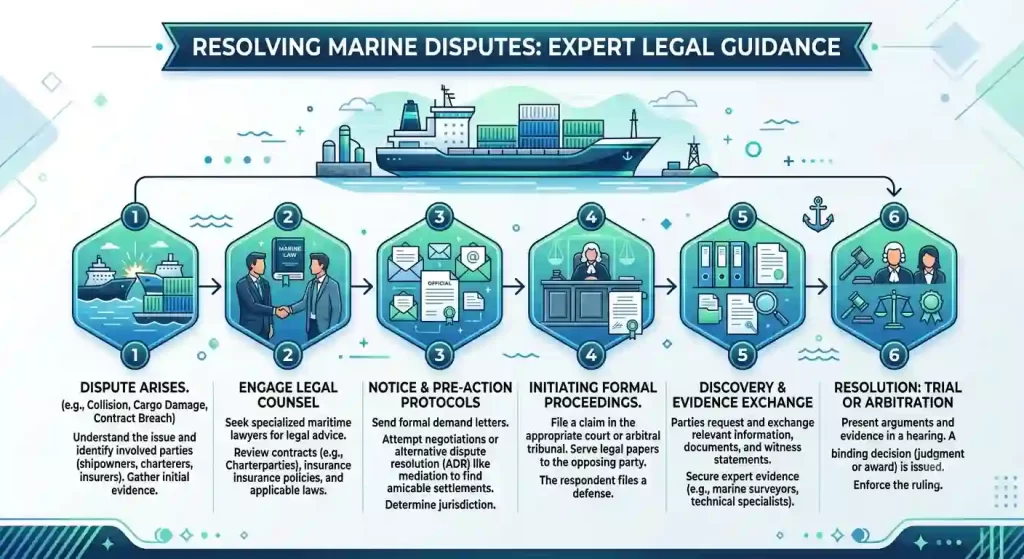
Every marine dispute requires remedies matching contractual rights and statutory protections. Therefore, legal strategy should begin immediately after discovering the dispute. Lawyers evaluate jurisdiction, limitation periods, evidence, insurance coverage, contractual clauses, and commercial objectives before filing proceedings. Early legal notices often encourage negotiated settlements. Nevertheless, litigation becomes necessary when negotiations fail. Courts may grant injunctions, compensation, vessel arrest, declaration orders, recovery decrees, interest, or specific contractual relief. Arbitration awards also provide enforceable commercial remedies. Businesses should preserve digital communications, invoices, cargo records, inspection reports, and payment details carefully. Timely compliance strengthens legal claims significantly. Rajendra Civil Law Firm provides comprehensive representation from legal notice through final execution proceedings while protecting valuable commercial relationships.
| Forum | Dispute Type | Available Relief |
|---|---|---|
| Admiralty High Court | Maritime claims | Ship arrest |
| Commercial Court | Contract disputes | Recovery decree |
| Arbitration Tribunal | Charter disputes | Arbitration award |
| Civil Court | Civil claims | Compensation |
Why Choose Rajendra Civil Law Firm for Marine Disputes
Marine disputes require legal knowledge, commercial understanding, and procedural precision. Therefore, clients benefit from experienced representation throughout every litigation stage. Our advocates examine contracts, insurance documents, cargo records, technical reports, statutory provisions, and judicial precedents thoroughly. Each strategy focuses upon protecting commercial investments and reducing operational disruption. Moreover, practical negotiations often save valuable business resources. When litigation becomes unavoidable, our lawyers prepare comprehensive pleadings and persuasive arguments. We represent exporters, importers, shipping companies, logistics businesses, insurers, banks, vessel owners, and cargo owners before competent authorities. Continuous client communication ensures informed decision-making. Every matter receives personalized attention based upon commercial priorities. Rajendra Civil Law Firm remains committed to achieving lawful, efficient, and commercially beneficial outcomes through strategic legal representation.
Marine Dispute Resolution Checklist
Businesses should adopt preventive legal practices before disputes escalate into expensive litigation. Consequently, structured compliance reduces commercial exposure. Maintain complete shipping documentation throughout every transaction. Preserve digital communications and payment records securely. Obtain independent cargo surveys whenever damage appears. Review marine insurance terms before accepting policy conditions. Verify jurisdiction and arbitration clauses carefully. Issue legal notices within limitation periods. Consult experienced maritime advocates before admitting liability. Coordinate with insurers and statutory authorities promptly. Monitor contractual performance regularly. Preserve electronic evidence according to applicable legal standards. These practical measures strengthen commercial claims while supporting successful dispute resolution before courts, tribunals, or arbitral forums.
Practical Checklist
- Review contracts.
- Preserve evidence.
- Notify insurers.
- Obtain survey reports.
- Issue legal notice.
- Verify jurisdiction.
- Seek legal advice.
- File proceedings promptly.
Conclusion
Marine disputes demand prompt legal action, technical evidence, and experienced advocacy. Therefore, businesses should never delay professional legal consultation. Indian maritime laws provide effective remedies through Admiralty High Courts, Commercial Courts, arbitration tribunals, and competent civil forums. The Admiralty Act, Merchant Shipping Act, CPC, Bharatiya Nyaya Sanhita, Bharatiya Nagarik Suraksha Sanhita, and Bharatiya Sakshya Adhiniyam collectively support dispute resolution where applicable. Early evidence preservation significantly improves litigation success. Proper jurisdiction selection also saves valuable time and costs. Rajendra Civil Law Firm provides comprehensive legal support for cargo claims, ship arrest, marine insurance disputes, charter party disagreements, freight recovery, maritime contracts, and commercial litigation. Our client-focused approach delivers practical legal solutions while protecting business continuity, commercial reputation, and financial interests across India’s maritime sector.
Frequently Asked Questions
Q1. Which court handles marine disputes in India?
Marine disputes generally proceed before Admiralty High Courts, Commercial Courts, Civil Courts, or arbitration tribunals. Jurisdiction depends upon the maritime claim, contract, vessel location, and applicable law.
Q2. Can a ship be arrested for unpaid maritime claims?
Yes. Eligible maritime creditors may seek vessel arrest under the Admiralty (Jurisdiction and Settlement of Maritime Claims) Act, 2017. Courts usually require supporting documents and valid maritime claims.
Q3. What documents support a cargo damage claim?
Bills of lading, invoices, survey reports, insurance policies, customs records, photographs, correspondence, delivery receipts, and expert reports usually strengthen cargo damage compensation claims.
Q4. Which laws commonly apply to marine disputes?
The Admiralty Act, Merchant Shipping Act, CPC, Arbitration and Conciliation Act, Bharatiya Nyaya Sanhita, Bharatiya Nagarik Suraksha Sanhita, and Bharatiya Sakshya Adhiniyam may apply.
Q5. Can marine disputes be settled without court proceedings?
Yes. Parties often resolve disputes through arbitration, mediation, negotiated settlements, or Lok Adalat where legally appropriate. Early legal advice usually improves settlement opportunities.
Q6. How can Rajendra Civil Law Firm assist in marine disputes?
Our firm advises on marine contracts, cargo claims, ship arrest, insurance disputes, charter party conflicts, commercial litigation, arbitration, recovery proceedings, and comprehensive maritime legal compliance.
Read More
- Pursuing Maintenance Cases: Legal Strategies for Success
- Legal Separation Simplified: Expert Guidance You Can Trust
- Issuing Legal Notices: Expert Guidance for Effective Communication
- Expert Legal Representation for Labor Issues
- Protecting Intellectual Property: Expert Legal Counsel
- Ministry of Ports, Shipping and Waterways (MoPSW)